The Lake
Lake Nyos sits in the northwestern highlands of Cameroon, in a volcanic crater roughly 1,800 metres above sea level. From above it is blue, clear, and surrounded by forested walls. Below, it is something else entirely.
The lake sits above a pocket of magma that has been seeping carbon dioxide into the deep water for a very long time. At depth, the pressure of the water column keeps the CO2 dissolved, the same principle that keeps carbonation in a sealed bottle. The lake is stratified: cold, dense, CO2-saturated water at the bottom; warmer, less saturated water on top. Under normal conditions, these layers do not mix. The gas accumulates, year by year, held in place by physics.
The amount of CO2 that can be held in solution at depth is enormous. By 1986, Lake Nyos had been accumulating gas for years without a major release. The bottom water was effectively supersaturated, holding far more dissolved CO2 than it could sustain if that pressure were removed. It was, in a sense, waiting.
August 21, 1986
At some point in the evening of August 21st, something disturbed the lake's stratification. The triggering event is still debated: a small landslide, a minor underwater volcanic disturbance, or possibly just the inherent instability of a layer that had become too heavily loaded to remain static. Whatever the cause, the deep water began to rise.
As it rose, the pressure decreased. As the pressure decreased, the dissolved CO2 came out of solution, the same way a shaken bottle sprays when opened. The released gas drove the water further upward. The process became self-reinforcing. The entire column overturned.
Between 100,000 and 300,000 tonnes of carbon dioxide erupted from the surface of the lake. Witnesses described a sound: a rumble, or a series of explosions. A fountain of water shot roughly 100 metres into the air. The white cloud that formed above the surface rose briefly, and then began to sink.
Carbon dioxide is approximately 1.5 times denser than air. It does not disperse upward like smoke. It settles into low-lying areas. It flows along valleys, following the terrain downhill, displacing breathable air as it goes. The cloud from Lake Nyos moved at speeds estimated between 20 and 50 kilometres per hour. It was approximately 50 metres thick as it traveled. It was invisible. It had no smell at detectable concentrations, though some survivors reported a faint odour of rotten eggs, indicating trace hydrogen sulphide from the deep water.
| Detail | |
|---|---|
| Date | August 21, 1986, evening |
| Location | Lake Nyos, Northwest Cameroon |
| CO2 released | 100,000–300,000 tonnes |
| People killed | 1,746 confirmed dead |
| Livestock killed | ~3,500 |
| Cloud radius | ~23 km from the lake |
| Villages devastated | Nyos, Kam, Cha, Subum |
| Survivors in Nyos village | 4 |
The Villages
The cloud traveled twenty-three kilometres from the lake before it dispersed to non-lethal concentrations. In that radius, it killed nearly everything at ground level.
In the village of Lower Nyos, a woman and her child were the only two survivors. In Nyos itself, four people survived. In the villages of Kam, Cha, and Subum, the death toll varied by elevation and by the specific path the gas took through the terrain. Those on higher ground had a chance; those in the valleys did not. Approximately 3,500 cattle and other livestock were found dead in the fields. Birds died in the trees. Insects died on the ground. Survivors who arrived at the scene the next day described a silence that was total and wrong.
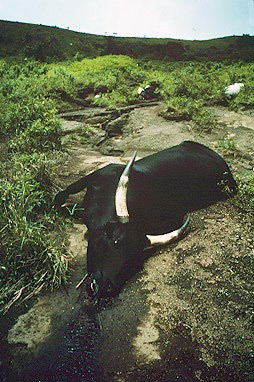
Ephriam Che, who lived on higher ground, discovered the disaster the following morning. He found his neighbours dead in their homes and in the road. He described the absence of flies on the bodies. The insects that would ordinarily appear immediately had also died. The lake's outlet waterfall was unnaturally dry. The morning chorus of birds and insects was completely absent.
"I was unable to walk, even to talk... my body was completely weak."
— Survivor account, village of Subum
Joseph Nkwain, from Subum, woke sometime during the night to find himself unable to move or speak. He managed eventually to reach his daughter. She was dead. His neighbours were dead in the road outside. He survived, but described weeks of severe weakness. Many survivors who had been at the edge of the cloud's concentration experienced respiratory problems, skin lesions, and partial paralysis in the months that followed, consistent with oxygen deprivation and the chemical effects of CO2 at sub-lethal concentrations.
The Morning After
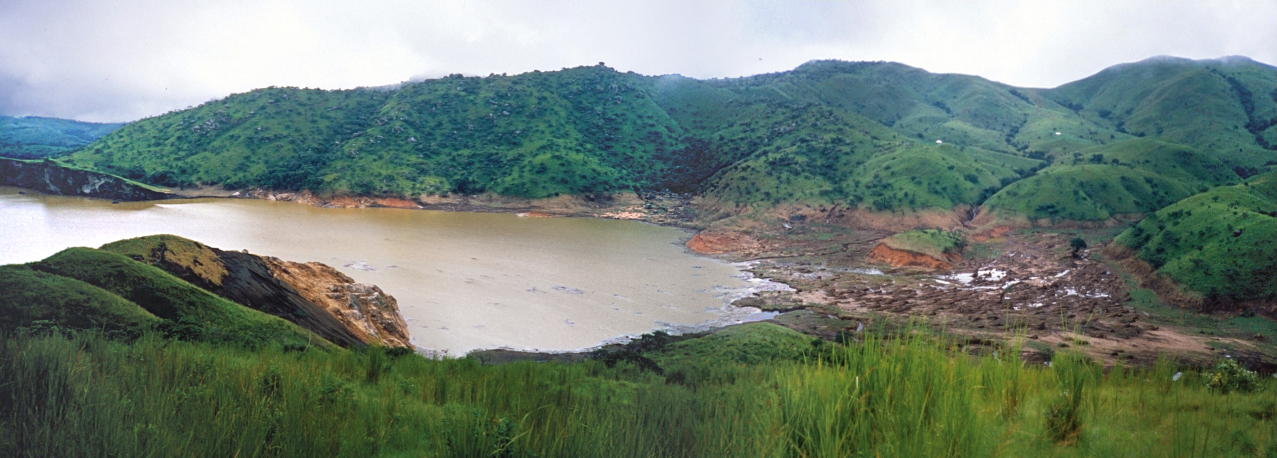
When rescue teams arrived the following day, the lake looked almost ordinary. The water, normally a clear blue, had turned a dull red: iron-rich sediment from the deep bottom had been churned to the surface during the overturn. The lake level had dropped by approximately one metre. The waterfall at the outlet was barely flowing.
But there was no visible catastrophe on the water itself. No wreckage. No sign of explosion. The trees on the shore had been stripped in a ring at certain elevations, evidence of the water spout, but the lake sat quiet in its crater, as if nothing had happened. The disaster was entirely invisible from above. It had happened in the air over the valleys, in the dark, while everyone was asleep.
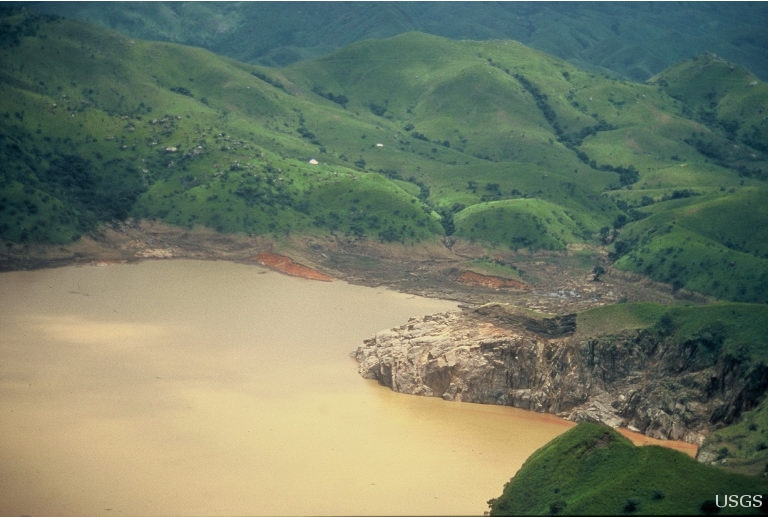
This detail proved disorienting for early investigators. They were looking for something to explain 1,746 deaths across a wide area, and the lake they found gave almost no indication of what it had done.
The Warning That Came Two Years Earlier
Lake Nyos was not the first. In August 1984, Lake Monoun, thirty-seven kilometres away and sitting above the same volcanic zone, had a smaller limnic eruption that killed thirty-seven people. The event was reported, investigated, and attributed to various causes. The mechanism was not yet understood clearly enough to trigger widespread alarm about the other crater lakes in the region.
When Lake Nyos erupted two years later, scientists finally had enough evidence to name what they were dealing with: a limnic eruption, the sudden large-scale release of dissolved gas from a deep stratified lake. Before 1984, such events had been unknown or unrecognized in modern scientific literature. Lake Monoun was only the first recorded instance. Lake Nyos was the second. And the worst.
The Fix
Understanding the mechanism opened the door to engineering a solution. If the CO2 accumulates under pressure in the deep water, the answer is to remove it continuously rather than let it build to catastrophic levels.
Starting in 2001, French and Cameroonian scientists installed a degassing pipe at Lake Nyos. A pipe runs from the surface to the deepest water layer. The CO2-saturated water at the bottom, under pressure, rises naturally through the pipe and releases its dissolved gas safely at the surface, a controlled, continuous version of the same physics that produced the disaster. When the pipe was first activated, it produced a fountain of water shooting nearly 50 metres into the air, driven entirely by the dissolved gas coming out of solution as the pressure dropped.
By 2019, engineers confirmed that a single pipe operating continuously could maintain safe CO2 levels indefinitely, removing as much gas as enters the lake each year from the volcanic seeps below. The lake has been partially degassed. Additional pipes were installed to accelerate the process. The system works. Lake Nyos is not made safe, exactly, but it is being managed.
Similar degassing systems have been installed at Lake Monoun. The technology transfers. The problem, as a technical problem, is solved.
Lake Kivu and the Ongoing Question
Lake Nyos holds roughly 300 million cubic metres of water. Lake Kivu, on the border between the Democratic Republic of Congo and Rwanda, holds approximately 550 cubic kilometres, nearly 2,000 times more volume. It sits above the same kind of volcanic zone, and studies have confirmed that its deep water is similarly saturated with dissolved CO2, as well as methane.
Two million people live along Lake Kivu's shores.
The question of whether Lake Kivu could undergo a limnic eruption has been studied extensively. Early assessments raised significant concern. A 2020 analysis found that the eruption risk at Kivu is not currently increasing in the way the 2005 study suggested, and that the lake's thermal stratification provides more stability than Nyos had. But the gas is there, the volcanic activity below is ongoing, and the population exposure is orders of magnitude larger than anything involved in 1986.
Scientists monitor Lake Kivu continuously. The lake's dissolved methane has actually become a resource, a power plant has been built to extract it for electricity generation, which simultaneously reduces the methane saturation. The CO2 question is more complex.
What Lake Nyos Changed
Before 1986, limnic eruptions were not part of hazard planning. The threat was unknown to the communities living near crater lakes in volcanic regions. After Nyos, scientists began surveying crater lakes globally for dissolved gas saturation. The category of "killer lake" entered the scientific vocabulary. International protocols for monitoring and intervention were developed.
The 1,746 people who died at Lake Nyos died from a hazard that had no name when they went to sleep that night. They died quietly, in their beds, from a lake that looked fine in the morning. The gas that killed them had been building for years, held in place by water pressure, invisible and patient, waiting for something to tip the balance.
The degassing pipes at Nyos represent one of the few cases where a geological hazard has been directly and durably addressed by human engineering. The lake is still there. The volcanic activity below is still ongoing. The pipes are running. The gas that rises through them now rises safely, dissipating into the air rather than rolling down into the valleys.
It is a quiet and improbable victory over an invisible thing.