By the standards of the northern Great Plains in January, January 12, 1888 was almost pleasant. Temperatures across the Dakota Territory, Nebraska, Minnesota, and Kansas were running ten to fifteen degrees above normal. In some locations they were above freezing. Farmers who had been huddled through the hard months felt the reprieve and acted on it: they went to town for supplies, started overdue outdoor work, let animals into the yard. Children left for school without their heaviest coats.
Why would they need them? The sky was clear. The air was soft. It was a school morning.
How a Plains Blizzard Works
The geography of the Great Plains creates weather conditions that exist nowhere else in quite the same form. The land is flat from Texas to Canada, open from the Rocky Mountains to the Mississippi. There are no mountain ranges to impede Arctic air from Canada, no hills to slow or redirect it. When a high-pressure system pushes cold Arctic air south, it moves across the plains essentially unobstructed.
The blizzards the plains produce are not primarily about snowfall totals. They are about wind and temperature differential. On January 12, 1888, a cold front moved south and east at approximately 60 miles per hour. The temperature behind the front was well below zero Fahrenheit. The temperature ahead of it was above freezing. The two air masses met with almost no transition.
In some locations, the temperature dropped between 18 and 22 degrees Celsius, as much as 40 degrees Fahrenheit, in under thirty minutes. The snow was not falling in flakes. The wind was driving fine, granular, dry particles horizontally. People described being unable to see their hands held in front of their faces.
The schools that morning had been full.
The Impossible Decision
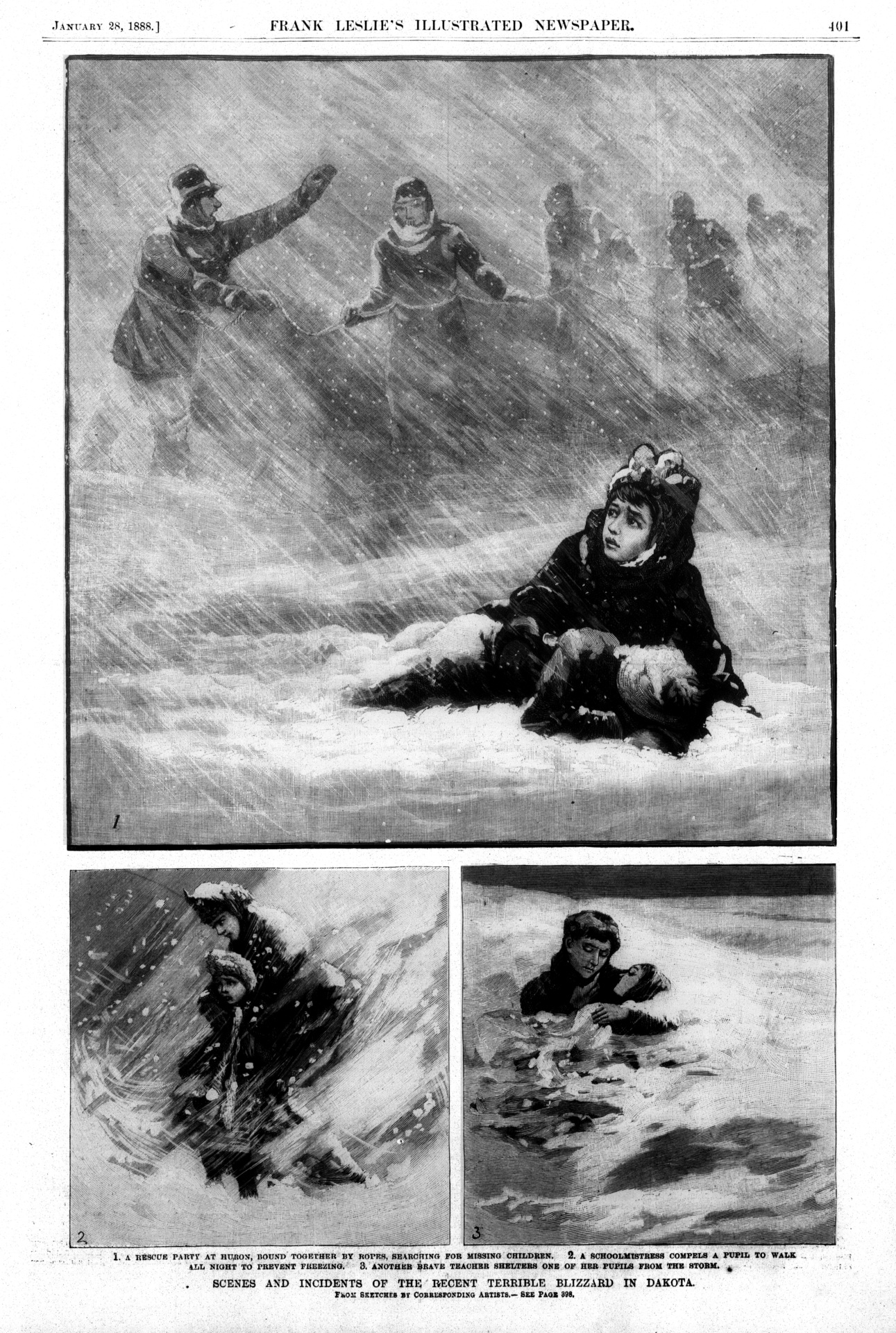
There were hundreds of one-room schoolhouses scattered across the affected region, and in each of them a single teacher faced the same decision within minutes: keep the children here and wait for parents to come, or start them for home while they could still see something.
It was genuinely impossible. Keeping children in the schoolhouse meant relying on enough fuel to last the night and trusting that parents would not exhaust themselves trying to reach children who were actually safe. Sending children home meant trusting that the storm would not worsen, that the paths they knew in clear weather would still be findable when the world had turned white in every direction.
Many teachers who kept their students in the schoolhouse saved their lives. Many teachers who sent children toward home sent them into a storm that would kill them within a few hundred yards of the door.
The Storm
Date: January 12, 1888, afternoon
Temperature drop: up to 40°F (22°C) in under 30 minutes in some locations
Cold front speed: approximately 60 mph
Region affected: Dakota Territory, Nebraska, Minnesota, Kansas
Death toll: approximately 235
Additional casualties: hundreds of amputations from frostbite in following weeks
Minnie Freeman
The name that emerged from the disaster — the one that appeared in newspapers from New York to London — was Minnie Freeman. She was eighteen years old and teaching school near Ord, Nebraska.
When the storm struck, the wind tore the door off her schoolhouse, then took part of the roof. The building was no longer shelter. Freeman made a decision: she would move the children to a farmhouse she knew was approximately a quarter mile away. She gathered her students, thirteen of them, tied them together with a length of clothesline rope, and led them through the blizzard.
All thirteen children and Freeman survived. By the time the story reached the eastern newspapers, she was "Nebraska's heroine teacher." She later described the decision with characteristic plainness: she had simply done what the situation required.
Lena Woolverton, teaching in a Kansas schoolhouse, kept her students inside through the night with almost no fuel, burning furniture and anything else she could find to keep the temperature above freezing. All survived. Her account was less celebrated nationally, but locally she was remembered with the same reverence.
Other teachers walked their students out. They were not found until the thaw.
Frozen Within Sight of Home
What David Laskin's careful reconstruction in The Children's Blizzard establishes, drawing on survivor accounts and contemporaneous records, is how the storm disorientated people who were utterly certain they knew where they were.
The horizontal, granular snow removed every visual reference. People who had walked the same quarter-mile path every day of their adult lives walked past their own houses and kept walking. People moved in circles without knowing it. People heard a barn, a dog, a clanging piece of farm equipment, walked toward it, and walked past it into the open prairie.
Children were found frozen within sight of their own schoolhouses. Some had made it to the fence line of the schoolyard and no further. The storm was so disorienting that distances trivial in clear weather became impassable in whiteout conditions. People died 100 yards from shelter that was full of warmth and light they never reached.
The frostbite toll was separate from the death toll and in some ways more shocking in its scope. Amputations of fingers, hands, feet, and lower legs were performed across the region in the weeks following the storm. Children who survived the night had sometimes lost sensation in their extremities within the first hour of exposure and had no way to know it. They kept walking until they fell.
The Warning That Never Came
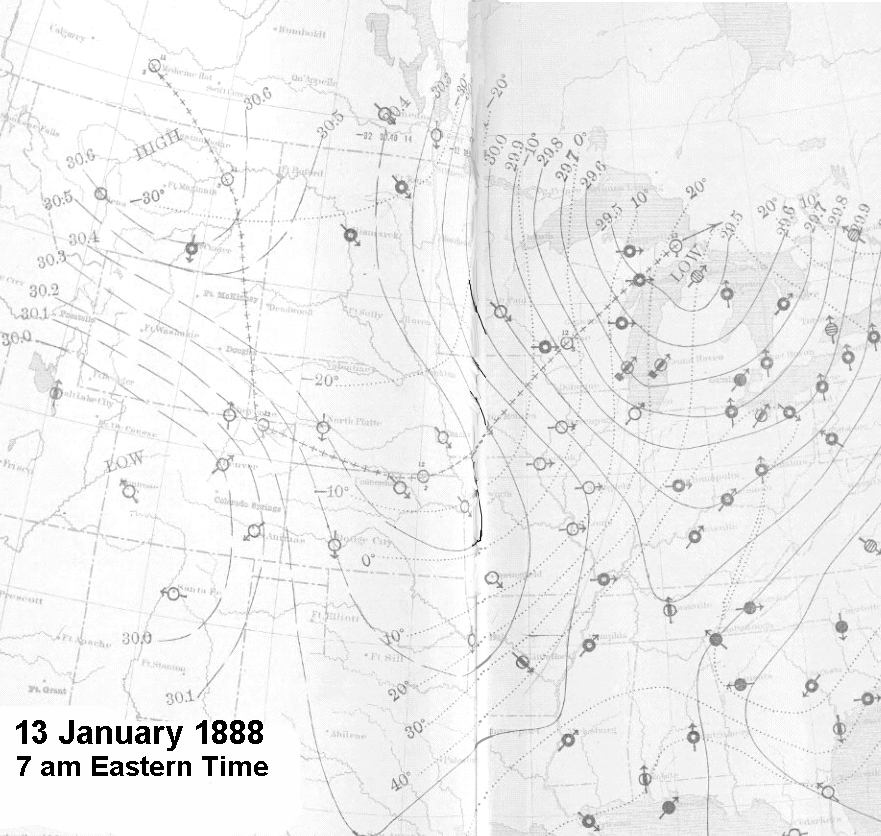
The United States Army Signal Corps was the weather bureau of the era. On January 11th and into the morning of January 12th, it had received reports of a fast-moving cold system advancing from the northwest. The data existed. The storm was visible in the observational record.
The warning was either not issued, or issued too late through channels that did not reach the people who needed it. Observers across the Dakotas and Nebraska received no adequate warning in time to close schools or call people indoors. The Signal Corps's general, William B. Hazen, faced congressional inquiry about the agency's performance in the weeks that followed.
The failure was not purely bureaucratic. Frontal meteorology — the science of predicting the movement of air mass boundaries — was not yet established practice in 1888. Forecasters had data about where the cold was. They did not have a reliable theoretical framework for predicting how fast the boundary would move, or how severe the temperature gradient would be on either side of it. The storm became one of the events that drove reform of the national weather system, contributing to the reorganization that produced the civilian U.S. Weather Bureau in 1890 under the Department of Agriculture.
January 13th was clear and bitter cold. The searching began. The story that emerged was one the country needed: a story of survival and human resourcefulness, of Minnie Freeman and her clothesline. That story is real and important. It coexisted with the other story, about a government that had been actively encouraging people to move onto unfamiliar land and had not provided an adequate warning system when the land showed them what it could do.
Both things were true. The newspapers preferred one of them.
Works Cited
- Schoolhouse Blizzard — Wikipedia
- Laskin, D. (2004). The Children's Blizzard. HarperCollins.
- The Children's Blizzard: January 12, 1888 — National Weather Service
- The Schoolhouse Blizzard — Smithsonian Magazine
- Minnie Freeman and the Children's Blizzard — Nebraska State Historical Society
- The Children's Blizzard of 1888 — History.com
- U.S. House of Representatives (1888). Report of the Signal Corps Operations, January 1888. Government Printing Office.
- United States Weather Bureau — Wikipedia
- Strand, T. (2011). Norwegian Immigrants and the Dakota Blizzard. Great Plains Research, 21(1), 45–63.