A White City on the Atlantic
In early 1960, Agadir was one of the most promising towns in Morocco. It sat on a sweep of Atlantic beach on the country's southern coast, a fishing port turning into a winter resort, with white buildings, new hotels, and a climate European tourists crossed the sea for. Above it all stood the Kasbah, a fortress quarter built in 1540 on a hill 236 meters over the bay. Below the hill sat Founti, the old fishing district at the waterline, with the crowded quarters of Talborjt and Yachech behind them and a newer European-style town to the south. Population counts from the period range from about 35,000 to 48,000 people.
Nobody thought of it as earthquake country. Morocco's seismic risk was assumed to live far to the north, near the Mediterranean. Agadir's buildings, from rammed-earth houses centuries old to concrete hotels finished months earlier, were designed with no earthquake provisions at all.
That assumption is the whole story. The city was about to take a direct hit from below, and nothing standing on it was built to survive one.
Fifteen Seconds on a Leap Night
There were warnings, though no one could read them. A tremor days earlier tilted the pictures on hotel walls. On the evening of February 29, the third night of Ramadan, another shock rattled the town. Time magazine's correspondents reported that it sent dozens of worshippers to the mosque in Talborjt to pray, confident, as one account put it, that God would not strike while they paid homage. The mosque came down on them less than an hour later.
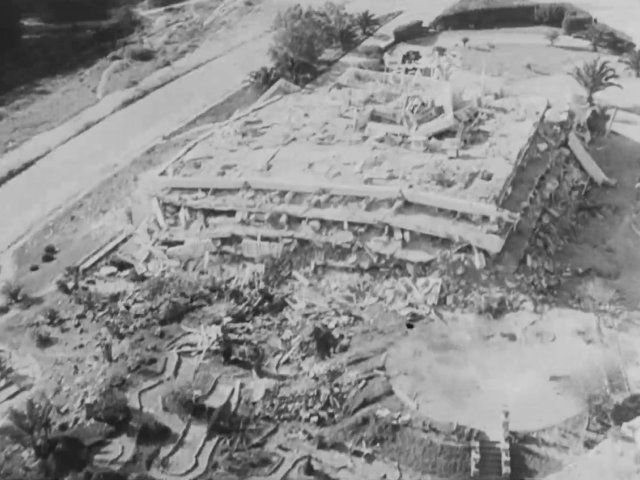
The main shock arrived at 23:40, when most of Agadir was asleep. It lasted less than fifteen seconds. In that time Founti, the Kasbah, and Yachech essentially ceased to exist, and most of Talborjt collapsed. The Saada, the newest and finest hotel in the city, pancaked onto its guests; the British author Robin Maugham was pulled from under a fallen beam, and an American officer's wife survived 38 hours in the wreckage. In the Kasbah, contemporary reporting put the dead at nearly two thirds of its 2,500 residents. Roughly 70 percent of the city was in ruins.
No authoritative death toll exists, because, as we will see, no one ever finished counting. The most cited range is 12,000 to 15,000 dead, with some Moroccan accounts putting it above 16,000. Around 12,000 more were injured and at least 35,000 left homeless. Out of a city of perhaps 40,000, that is roughly one person in three gone before midnight, on a date that only exists in leap years.
Why a Small Earthquake Destroyed a City
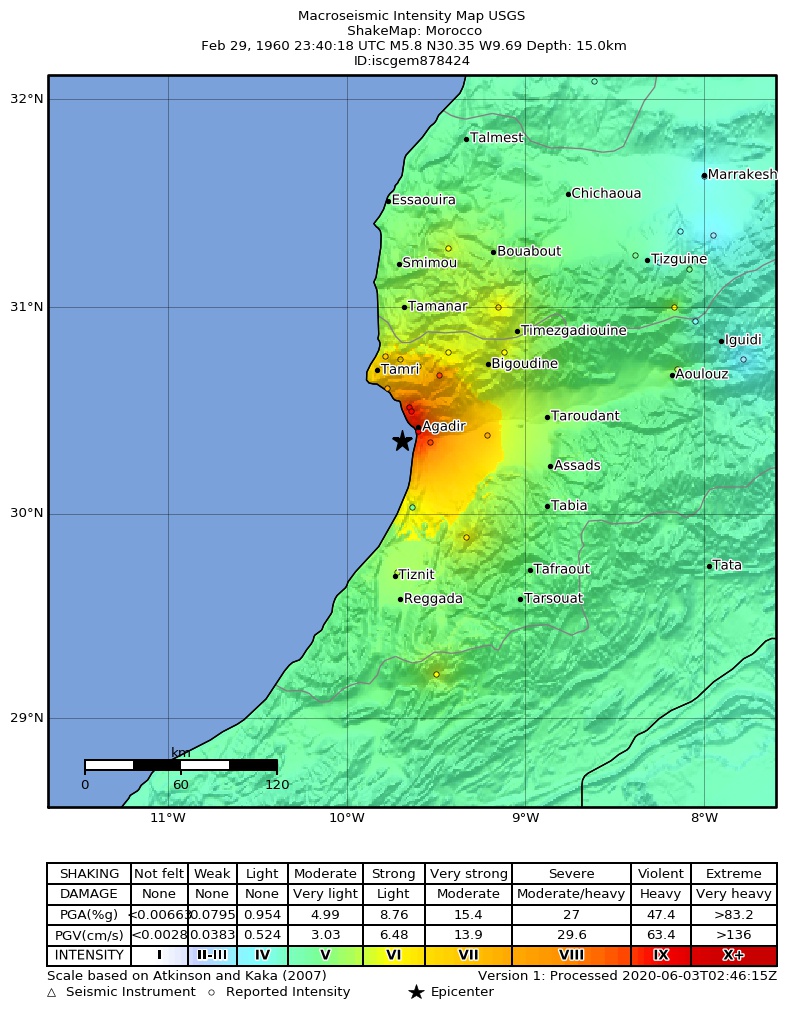
Here is the fact that makes Agadir a case study in engineering courses to this day: the earthquake was not big. Catalogs place it between magnitude 5.7 and 5.9. Quakes of that size happen somewhere on Earth almost every day. In most places they crack plaster, knock goods off shelves, and make the evening news for an hour.
Magnitude, though, only measures the energy released at the source. What a city experiences depends on how far away that source is, and at Agadir the distance was almost nothing. The focus was shallow, with estimates ranging from about three kilometers to fifteen, and the epicenter sat essentially beneath the town, roughly two kilometers from its center by the USGS reckoning. Seismic waves lose strength rapidly with distance. Agadir was denied that mercy. The full force of the rupture arrived at the surface almost undiluted, and shaking in the city reached X, Extreme, on the Modified Mercalli intensity scale, a rating normally associated with far larger events.
Then the ground motion met the buildings. The American Iron and Steel Institute sent an engineering team, including Ray Clough of Berkeley, to survey the ruins that March. Their report became a classic. Unreinforced masonry failed wholesale. The old rammed-earth structures, in the survey's words, disintegrated completely into dust. About 60 percent of the city's entire property value was destroyed or damaged in a quarter of a minute. A moderate earthquake, a shallow focus, a city directly on top, and not one building designed to resist it: each factor multiplied the others.
For scale, consider what happened three months later. In May 1960 the largest earthquake ever recorded, magnitude 9.5, struck southern Chile releasing thousands of times more energy. It killed fewer people than the fifteen seconds at Agadir.
| Item | Detail |
|---|---|
| Date and time | February 29, 1960, 23:40 local (leap day, third night of Ramadan) |
| Magnitude | 5.7 to 5.9 depending on catalog |
| Focal depth | Shallow; estimates from ~3 to 15 km |
| Max intensity | X (Extreme), Modified Mercalli |
| Duration | Under 15 seconds |
| Dead | 12,000 to 15,000+ of a population of ~35,000 to 48,000 |
| Districts lost | Founti, the Kasbah, Yachech; most of Talborjt |
The Wave That Never Was
One detail from the first wire reports refuses to die: the tidal wave. Newspapers in March 1960 described the sea sweeping hundreds of meters into the broken city. The engineers who surveyed the harbor found no evidence it ever happened. Moored ships reported swells, and harbor cranes toppled, but from ground subsidence, not water. A seismological review a few years later agreed. Agadir was destroyed by the ground alone. The wave belongs to legend.
The Rescue
Help came fast, and from everywhere. A French naval air base nearby sent men and equipment within hours. King Mohammed V broadcast an appeal and flew in with his son, Crown Prince Moulay Hassan, who took personal command of the relief effort in the ruins. Because it was Ramadan, the King, as the country's religious leader, granted rescue workers a dispensation to break the fast.
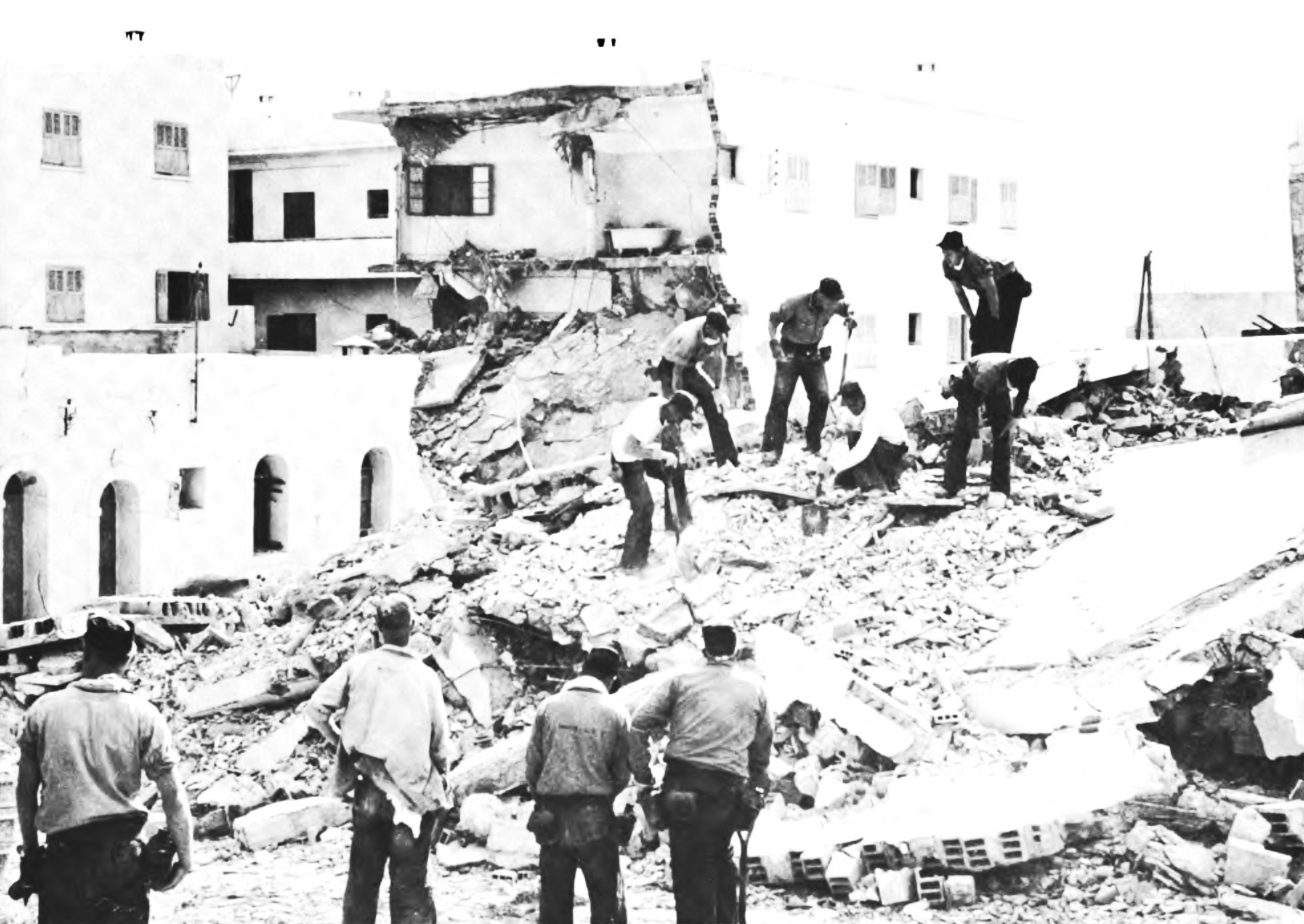
The response became one of the first great international disaster operations of the modern era, some 8,000 personnel in all. American bases in Morocco sent around 300 men with bulldozers, generators, and portable operating rooms; helicopters flew from Ben Guerir, medics from Port Lyautey, and U.S. Navy and Marine aircraft evacuated more than 400 of the badly injured in the first 48 hours. The cruiser USS Newport News ran from the central Mediterranean at an average of 31 knots to deliver medics, power, food, and water. A Dutch naval squadron exercising off Gibraltar diverted at the Crown Prince's request and took over the shattered Founti district. Britain sent ships from Gibraltar, including the depot ship HMS Tyne with her hospital. Survivors were still being found days in, pulled from voids in the rubble while voices called out in French, Arabic, German, Swedish, and English.
The King's Decision
Then came the choice that still defines Agadir. The city lay in a warm climate with thousands of dead beneath the rubble, and physicians warned that epidemic disease could finish what the earthquake had started. About three days in, the order came to halt the organized search and evacuate the survivors. The decision provoked outrage at the time, in Morocco and abroad, and under pressure the digging briefly resumed; a few more people were brought out alive over the following days. But the direction was set. The living would leave, and the city would be closed.
Mohammed V stood in the ruins that week and made a promise that is now carved into a memorial wall facing Agadir's city hall.
"If destiny decided the destruction of Agadir, its rebuilding depends on our faith and our will."
King Mohammed V, March 1960, as inscribed on Agadir's Wall of Remembrance
The City They Sealed
What happened next is the part almost no one remembers. The old city was never dug out.
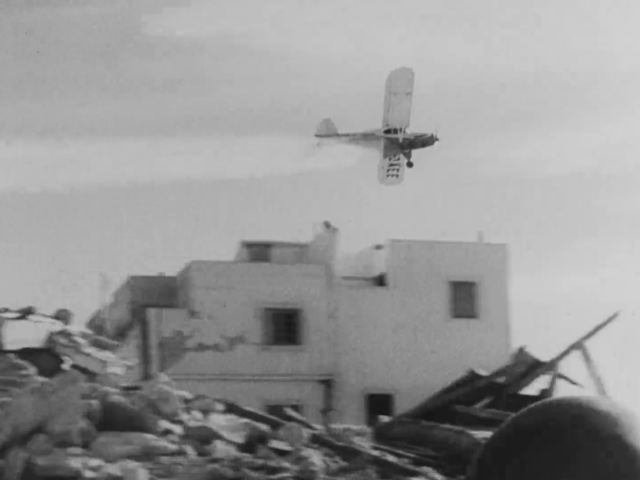
To stop disease, the authorities treated the ruins as ground that could not be reopened. DDT and disinfectant were sprayed across the rubble from lorries and from aircraft overhead. Quicklime was spread over the zones where rescue had been judged hopeless. French marines dug a mass grave at Ihchach; American bulldozers cut long trenches for the dead who could be reached. Thousands more never were. They remain today where the fifteen seconds left them, under the fallen quarters of Founti, the Kasbah, Yachech, and old Talborjt.
The ruined quarters north of the Oued Tildi were then written off entirely. Old Talborjt was razed flat and declared non-buildable, a legal designation it holds to this day. The Kasbah hill was left as it fell. The old Agadir was not rebuilt, not exhumed, not memorialized with excavation. It was sealed, an accidental necropolis beside the sea.
The New Agadir
The rebuilding began almost immediately, and deliberately elsewhere. On June 30, 1960, Mohammed V laid the first stone of a new Agadir south of the sealed zone, roughly two kilometers from the old quarters. A reconstruction authority was created that summer, a master plan drawn by August, and in December 1960 Morocco adopted its first seismic building code, the Normes Agadir 1960, written directly out of the disaster. Even Le Corbusier was consulted.
The city that rose is unlike anywhere else in Morocco: a planned showcase of modernist concrete architecture by Moroccan and French architects such as Jean-François Zevaco and Elie Azagury, low, white, and built to move with the ground rather than shatter on it. It worked. Agadir today is home to roughly half a million people, around a million in the metro area, and it is Morocco's leading beach resort, second only to Marrakech in visitors. Millions of tourists sunbathe each year beside a buried city most of them never learn is there.
The Hill Today
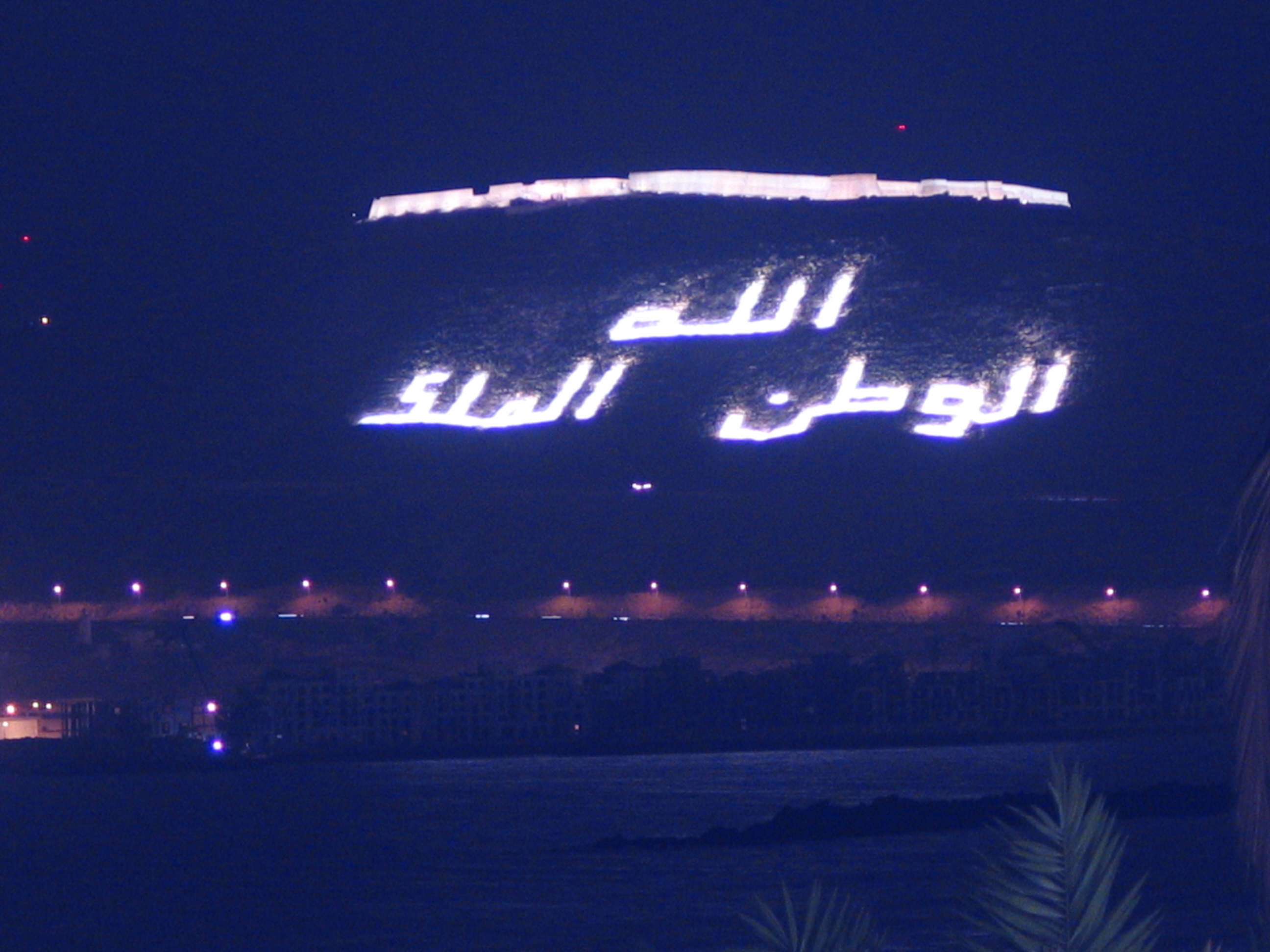
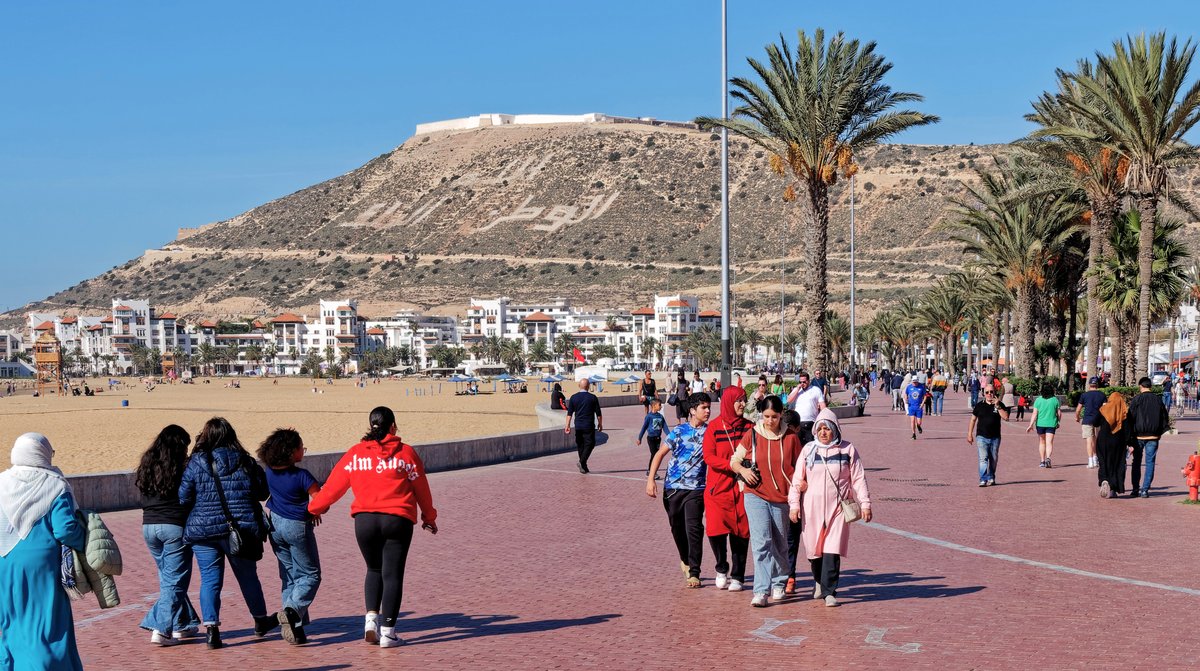
The Kasbah hill is the place where the whole story becomes visible. The fortress walls on the summit were restored between 2020 and 2024, and since 2022 a cable car carries visitors up from the new city. But the ground inside is not ordinary ground, and the restoration treats it that way. Visitors move on a raised wooden walkway built, in the words of the official restoration project, to respect the memory of the victims by letting people walk around the place without setting foot on the ground. What lies beneath the surface of that hilltop has been left exactly as February 29, 1960 arranged it.
On the hillside below, facing the bay, Morocco's national motto is written in giant Arabic letters and lit at night: God, the Homeland, the King. From the beach of the new Agadir you can see it glowing above the harbor, a crown on a hill that is both a monument and a grave.
The old city is still there. It was never dug out. It was closed.