The Quiet Green Mountain
For most of living memory, Mount Pinatubo was not a mountain anyone feared. It rose only about 1,745 meters out of the Zambales range in Central Luzon, and its slopes were so thickly forested and so ordinary that many people nearby did not even know it was a volcano. Its last major outburst came before the Spanish galleons, roughly 500 years earlier. The memory of it had faded into legend.
Living on those green slopes were the Aeta, one of the oldest indigenous peoples in the Philippines. They had farmed and hunted the highlands for generations, and they regarded Pinatubo as the home of their god, Apo Namalyari. Below the mountain the land was crowded. Angeles City held around 150,000 people. The sprawling Clark Air Base and, farther south, the U.S. Naval Base at Subic Bay put two of the largest American installations overseas almost in the volcano's shadow. Something close to a million people lived within reach of it. Almost none of them thought of the mountain as a threat.
The Waking, Spring 1991
The first hint came from far away. On July 16, 1990, a magnitude 7.8 earthquake struck Luzon about 100 kilometers northeast of Pinatubo, the deadliest quake in modern Philippine history. It may have disturbed the volcano's deep plumbing. Over the following months the mountain grew restless. By March 1991 the Aeta on the upper slopes were feeling small tremors and hearing rumbles. On April 2, the mountain finally spoke. A line of steam blasts tore open a fissure about 1.5 kilometers long on the north side, dusting nearby villages with ash. It was the first sign in centuries that Pinatubo was alive.
What happened next is one of the great stories in the history of science. A joint team from the Philippine Institute of Volcanology and Seismology, led by its director Raymundo Punongbayan, and the U.S. Geological Survey's Volcano Disaster Assistance Program, including scientists such as Chris Newhall and seismologist David Harlow, rushed in and began wiring the mountain with seismometers and tiltmeters. They were, in effect, trying to read the mind of a volcano nobody had ever monitored, in a race against an eruption that could come at any moment.
The instruments told an alarming story. Earthquakes that had begun several kilometers down marched steadily upward toward the summit. The volcano's sulfur-dioxide output soared, from about 500 tonnes a day on May 13 to some 5,000 tonnes a day by May 28, proof that fresh magma was rising. Then the gas output dropped sharply, a sign that the vent had plugged and pressure was building underneath like a shaken bottle. Tiltmeters showed the whole mountain quietly swelling.
Convincing a Million People
Reading the volcano was only half the battle. The harder half was getting a million people to believe it. As the USGS put it, "Local disbelief that Pinatubo was even a volcano, much less one that could erupt, posed a horrific challenge for scientists and civil defense leaders." The team built two simple tools that proved, in the words of the same account, "remarkably accurate." One was a hazard map showing where the deadly flows and ashfalls were likely to reach. The other was a five-level alert scheme plain enough for officials and ordinary people to follow.
To make the danger real, they screened a blunt documentary of past volcanic disasters filmed by the French volcanologists Maurice and Katia Krafft, footage that, the USGS notes, "grabbed even the skeptics' attention." One hard-won lesson framed the whole effort. Technical accuracy in a warning is not enough. It must also convince the people at risk to act.
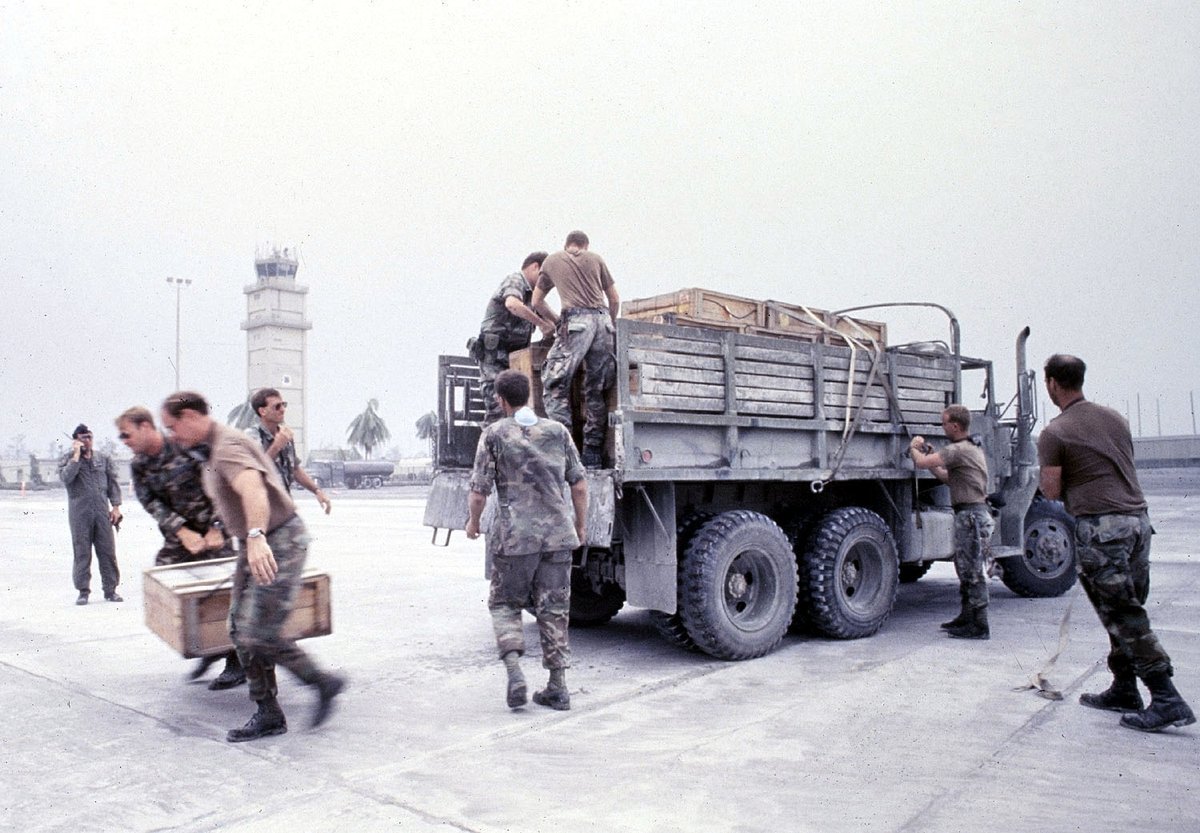
It worked. Evacuations rippled outward as the alert level climbed, first the innermost 10 kilometers, then wider rings. The Aeta abandoned their villages, many relocating more than once. By the eve of the climactic eruption more than 60,000 people had cleared the 30-kilometer danger zone, and in total the warnings moved an estimated 75,000 people to safety. The U.S. military launched Operation Fiery Vigil, evacuating tens of thousands of service members and their families from Clark and Subic.
The Cataclysm, June 12 to 15
The mountain gave a running start. On June 12, Philippine Independence Day, Pinatubo sent a column of ash and steam soaring roughly 19 kilometers into the sky. Bigger blasts followed on the 13th and 14th. These were only the overture.
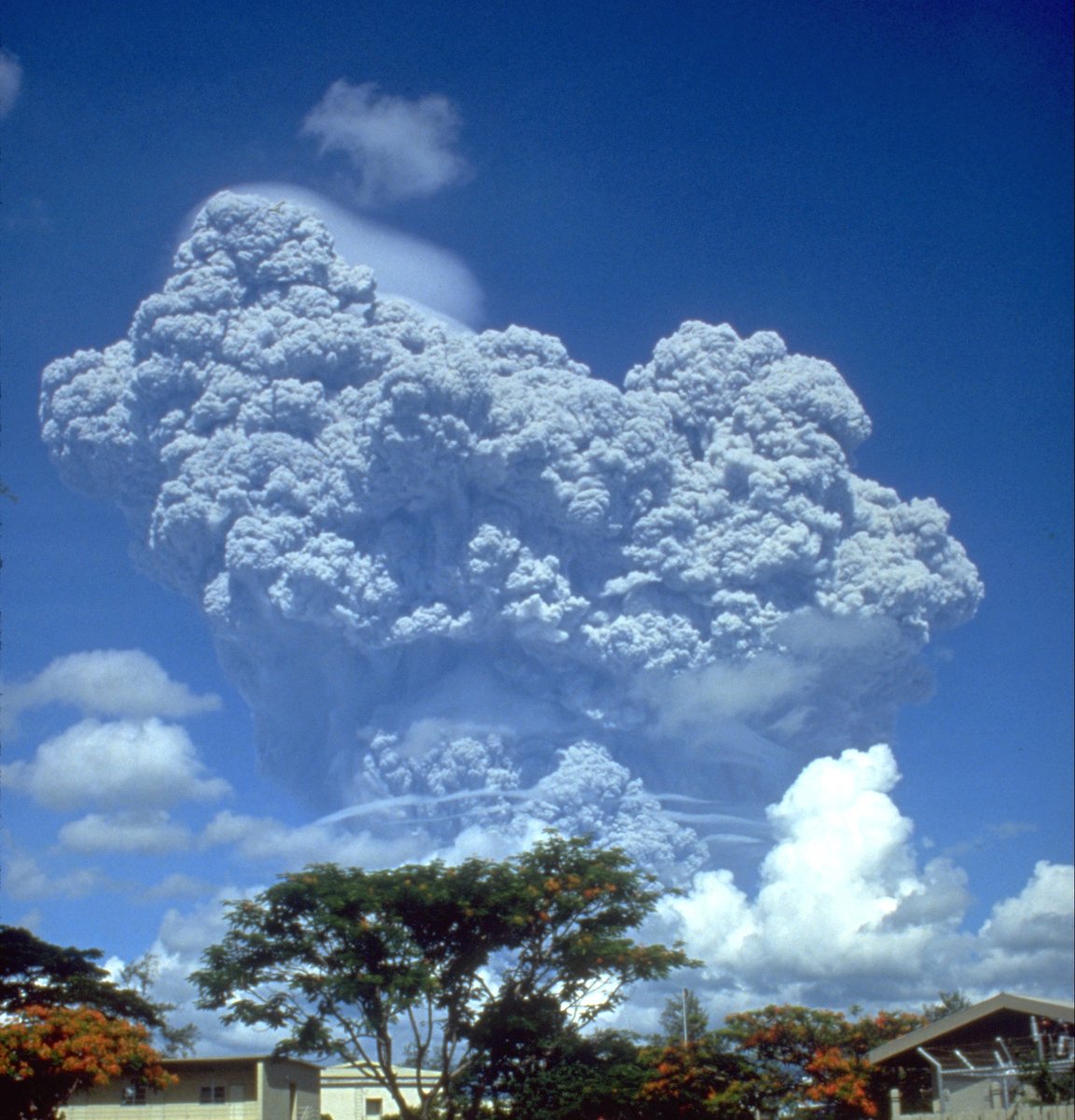
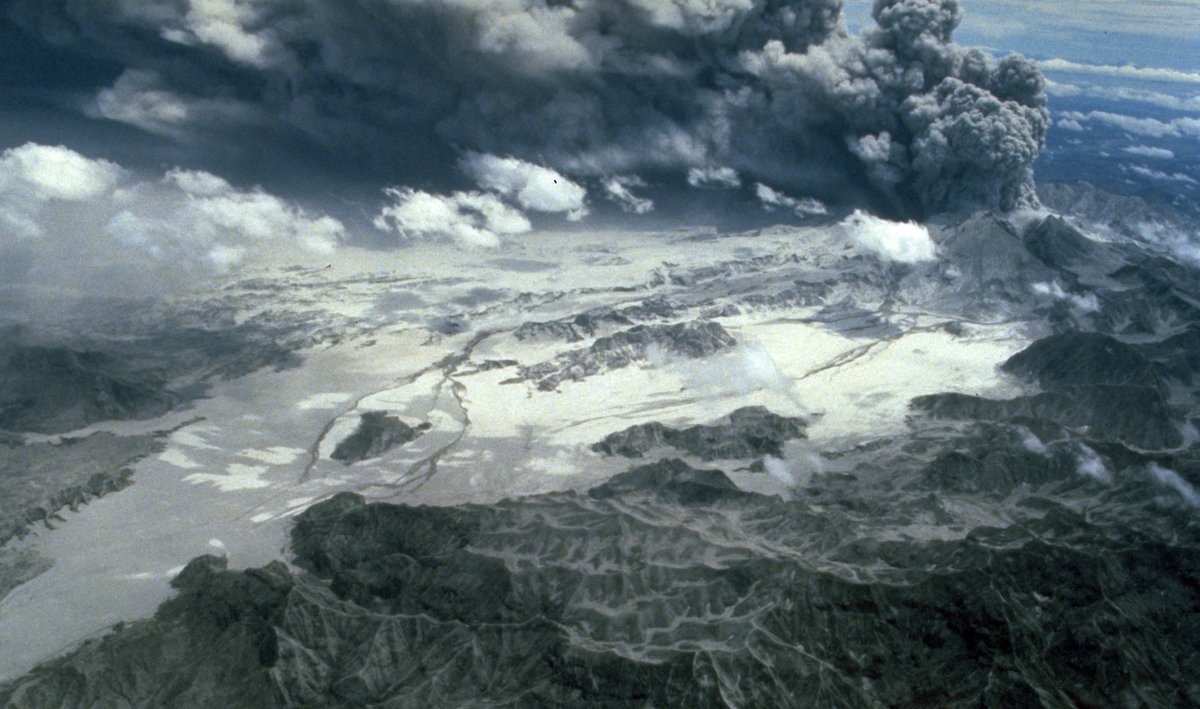
At 1:42 in the afternoon on June 15, 1991, the climactic eruption began. For about three hours Pinatubo unleashed the second-largest volcanic eruption of the twentieth century, rated VEI 6 on the Volcanic Explosivity Index, surpassed only by Novarupta in Alaska in 1912. It expelled on the order of 5 cubic kilometers of magma, roughly ten times the volume of the 1980 Mount St. Helens eruption. The column punched some 34 to 40 kilometers high, deep into the stratosphere. Pyroclastic flows, the searing avalanches of gas and ash, poured down the flanks as far as 16 kilometers and buried about 400 square kilometers of countryside under hot deposits up to 200 meters thick.
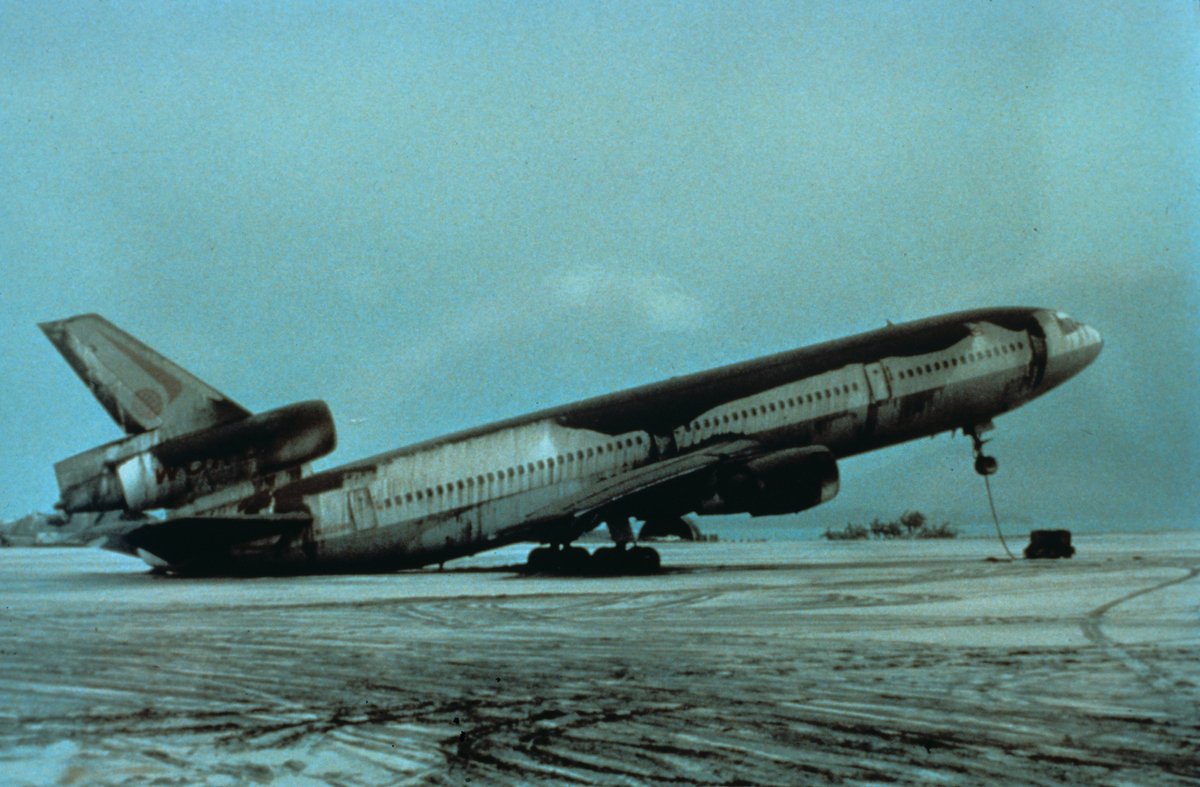
Then came a cruel coincidence. Typhoon Yunya, known locally as Diding, was crossing Luzon at that exact moment, passing about 75 kilometers north of the volcano. Its rain soaked the falling ash and turned a dry dusting into a heavy wet cement that rained down over an enormous area. Under that sodden weight, roof after roof buckled and collapsed. Most of the people who died in the eruption itself were killed not by lava or flame but by caving-in roofs. When the sky finally cleared, the summit was gone. The top 250 meters had collapsed into a new caldera 2.5 kilometers across, dropping the peak from 1,745 meters to about 1,486.
The Toll, and the Save
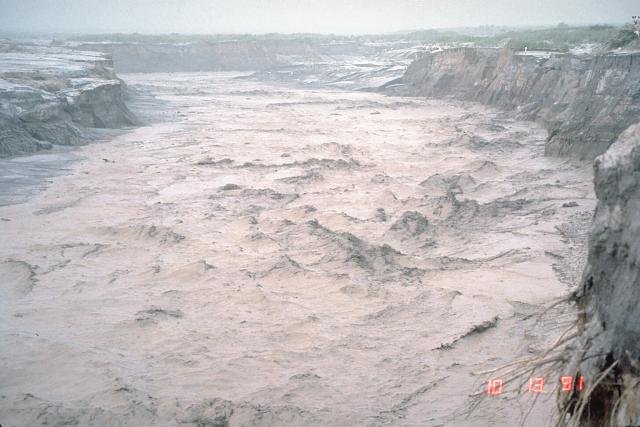
Roughly 800 to 850 people died in connection with the eruption, with about 847 the figure most often cited. Most were killed by collapsing roofs during the ashfall. More died in the following weeks and years from lahars, the volcanic mudflows that rampaged down river valleys with every heavy rain, and from disease in the crowded evacuation camps, including a measles outbreak that hit Aeta children especially hard.
But the number that matters most is the one that never happened. As the USGS "Fire and Mud" volume states plainly, "Although Pinatubo threatened 1,000,000 people, only a few hundred perished." The forecasts and evacuations are credited with saving at least 5,000 lives and around 250 million dollars in property. It stands as one of volcanology's greatest success stories. This was the biggest eruption most people alive had ever seen, and yet, thanks to science, far from the deadliest.
"Although Pinatubo threatened 1,000,000 people, only a few hundred perished."
— USGS, Fire and Mud: Eruptions and Lahars of Mount Pinatubo
The Whole Planet Cools
Pinatubo's most astonishing effect was felt nowhere near the Philippines. The eruption injected something like 15 to 20 million tonnes of sulfur dioxide into the stratosphere, the largest such cloud ever measured by modern instruments. Up there the gas combined with water to form a fine haze of sulfuric-acid droplets that, within about a year, had wrapped the entire globe.
That aerosol veil acted like a planet-wide sunshade, reflecting a slice of the Sun's energy back into space before it could warm the ground. The amount of sunlight reaching the surface fell by roughly a tenth. Global average temperatures dropped by about 0.4 to 0.5 degrees Celsius, close to a full degree Fahrenheit, with the Northern Hemisphere cooling even more. The chill lasted about two years, into 1993. For a brief window, one mountain in Luzon had turned down the temperature of the whole world.
The veil left other marks. It chewed at the ozone layer, driving mid-latitude ozone to record lows and stretching the Antarctic ozone hole to its largest size to that date in 1992. Skywatchers noticed it too. For months, sunsets blazed with strange color, and total lunar eclipses turned the Moon eerily dark.
| Measure | Value |
|---|---|
| Climactic eruption | June 15, 1991, VEI 6 |
| Magma erupted | ~5 cubic kilometers |
| Column height | 34 to 40 km into the stratosphere |
| People evacuated | ~75,000 |
| Deaths | ~847 |
| Sulfur dioxide released | 15 to 20 million tonnes |
| Global cooling | ~0.5 °C for about two years |
What Popular Accounts Get Wrong
Pinatubo is often called the biggest eruption of the century. It was the second largest. Novarupta in 1912 was bigger, though it struck a remote corner of Alaska where almost no one lived. Pinatubo is better described as the largest eruption in living memory to hit a densely populated place.
It is also remembered as a catastrophe that killed thousands. The astonishing part is the opposite. With a million people in harm's way, a toll of a few hundred is a triumph of prediction, not a mass-casualty failure. And while you will read that the eruption caused an ice age or a year without a summer, the cooling was real and measured but modest, about half a degree, and temporary. It did not rewrite the climate. It briefly nudged it.
The most remarkable footnote is that the cooling was predicted before it arrived. NASA's James Hansen used Pinatubo as a live test of his climate model, forecasting roughly the half-degree dip that followed. It became a landmark validation of the same kind of models now used to study global warming.
Legacy and Lake Pinatubo
Pinatubo became the best-monitored large eruption in history and a permanent case study in how to empty a volcano's slopes and save lives. Its perfectly measured cooling handed climate scientists a natural experiment that still anchors debates about the atmosphere. It is the go-to real-world example whenever anyone proposes solar geoengineering, the idea of cooling the planet on purpose by seeding the stratosphere with reflective particles.
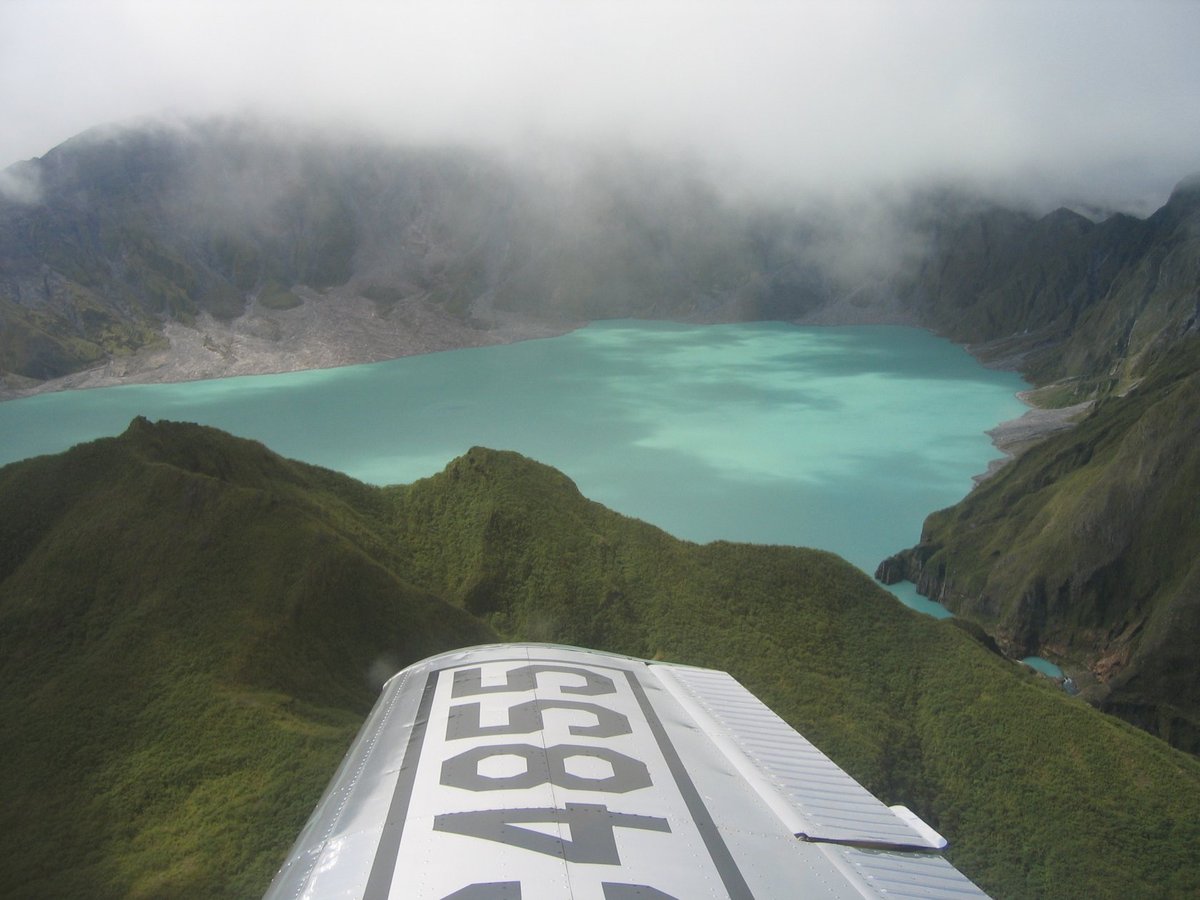
On the mountain itself, the ending is gentle. Monsoon rains slowly filled the new caldera to form Lake Pinatubo, a startling turquoise crater lake where a forested green peak once stood. It was hot and acidic at first, then cooled and calmed over the years. Today it is a quiet tourist destination, a serene postcard of blue water sitting on top of the twentieth century's second-greatest volcanic convulsion.