The Columns That Went Underwater and Came Back
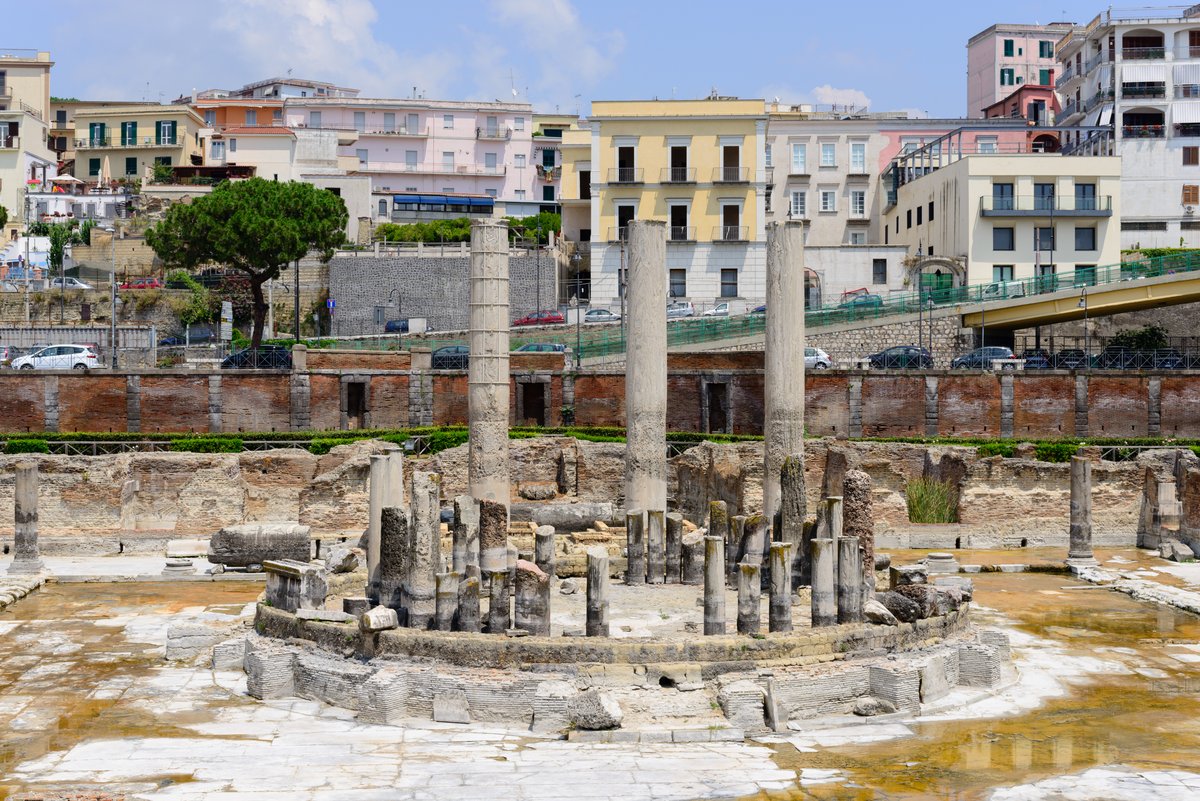
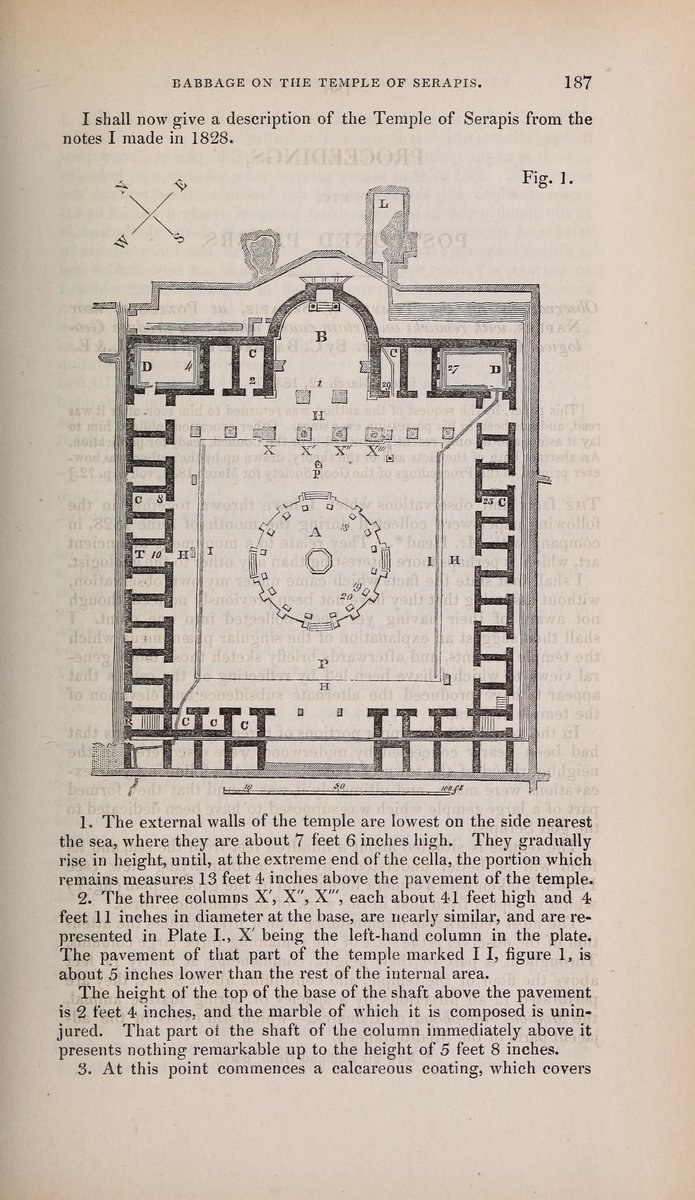
If Campi Flegrei has one iconic image, it is a set of three tall marble columns standing in a Roman ruin at Pozzuoli, a harbour town just west of Naples. For centuries the building was known as the Temple of Serapis. It is nothing of the kind. It is a macellum, a Roman market hall from roughly the first or second century AD, where fishmongers and grocers once traded under a colonnade. The columns are what survive.
Look partway up the marble and you find something that does not belong on a temple. Around three to four metres above the present floor, each column carries a ragged band of dark holes. They were not carved by masons. They were bored by Lithophaga lithophaga, the Mediterranean date mussel, a bivalve that drills into stone only where that stone lies beneath the sea.
The story those holes tell is quietly astonishing. The columns were raised on dry land. Then the ground sank, lowering their bases below sea level, where the mussels colonised the marble and drilled their neat rows. Then the ground rose again, lifting the borings clear of the water to the height a visitor sees today. A single Roman ruin, still standing, records the sea swallowing it and then handing it back. The nineteenth-century geologist Charles Lyell was so struck by the columns that he set an engraving of them on the frontispiece of his Principles of Geology, as proof that the solid ground is in slow motion.
The Caldera Under Naples
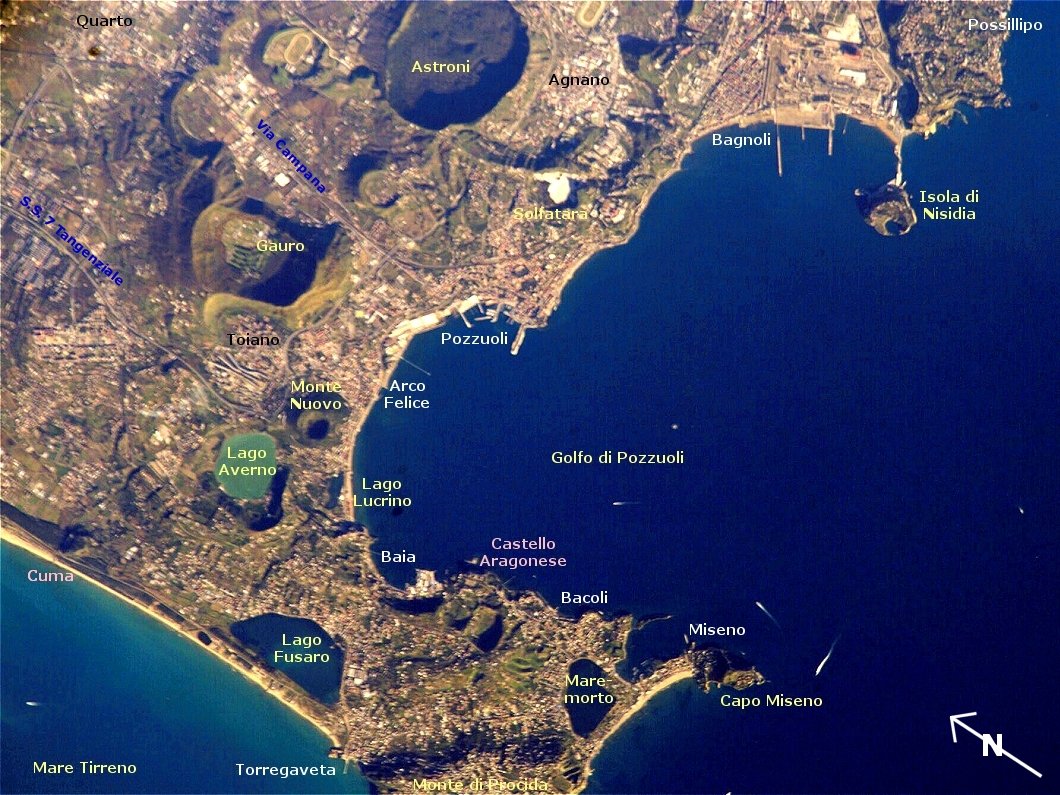
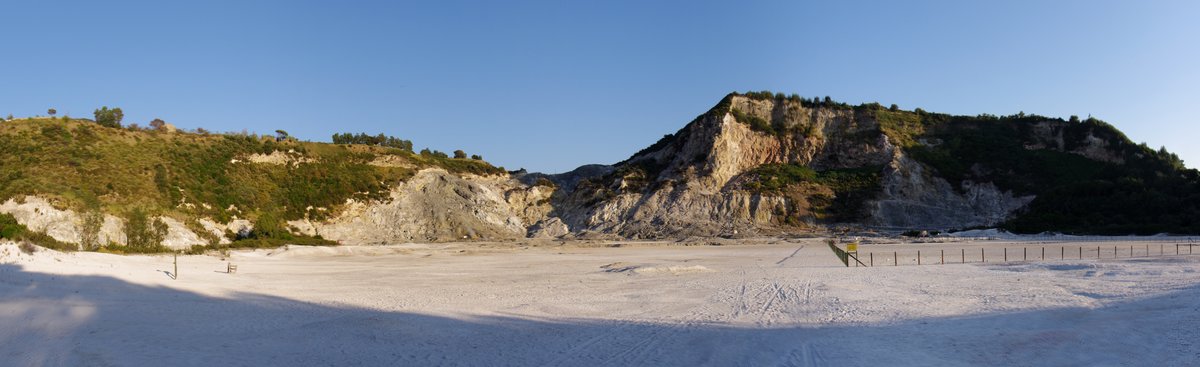
West of Naples, past the tunnels that burrow under the Posillipo ridge, the coastline loosens into a broken, steaming, half-drowned landscape the Romans called the Campi Flegrei, the burning fields. It looks like ordinary Italian suburbia. Apartment blocks, a fishing harbour, lemon trees, a Roman ruin or two. But the whole district sits inside the collapsed bowl of one of the most closely watched volcanic systems on Earth.
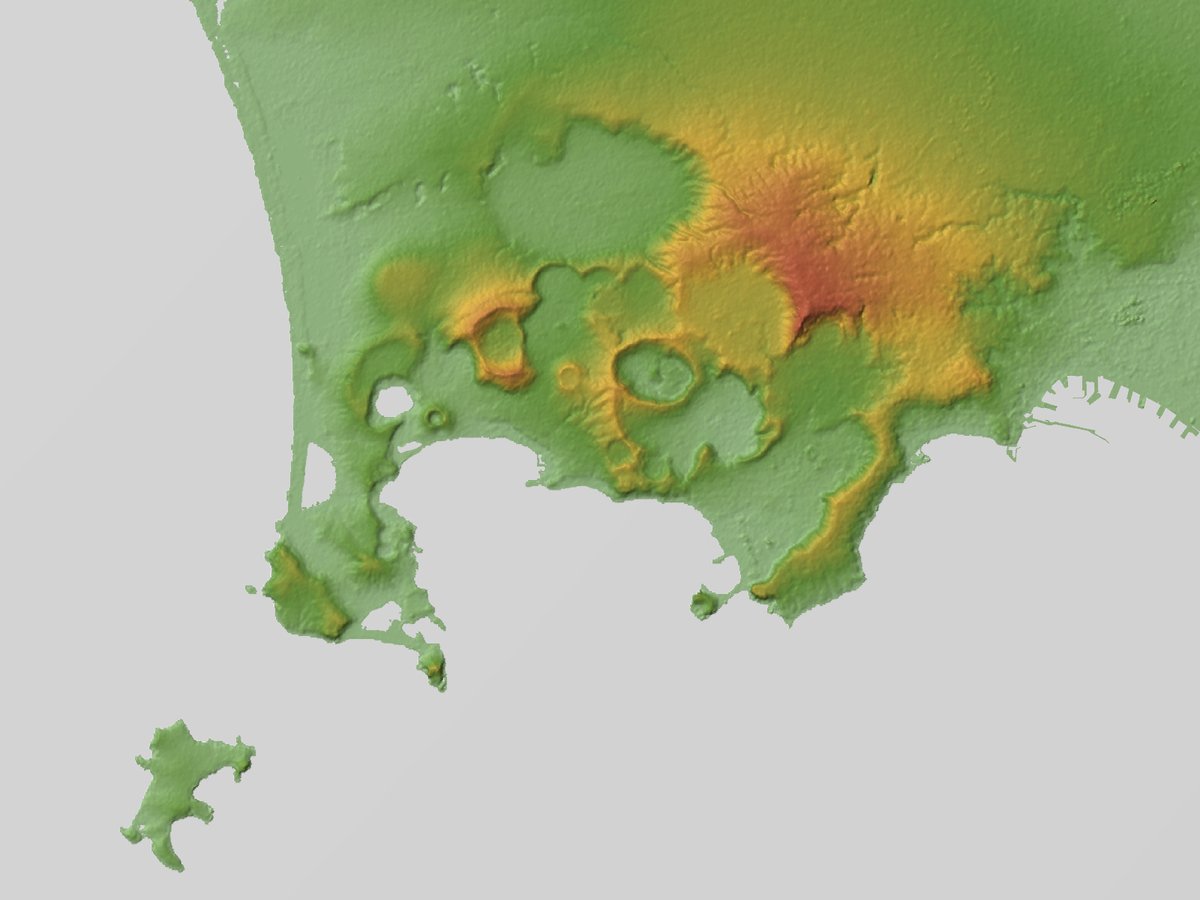
There is no single cone to point at, the way you can point at Vesuvius across the bay. Here the volcano is the landscape. It is a caldera roughly 12 to 15 kilometres across, studded with 24 craters and volcanic edifices, most of them now hidden beneath the town of Pozzuoli and the waters of the Bay of Pozzuoli. That is what makes the place so unsettling and so fascinating. Around half a million people live inside or directly over the caldera, with roughly three million in the greater Naples area close by. And unlike almost anywhere else on the planet, here the ground itself visibly rises and falls across years and decades, slowly enough to live with, fast enough to measure.
Not Vesuvius, and Something Stranger
It is easy to confuse the two, but Campi Flegrei is a separate system from Mount Vesuvius, which stands about nine kilometres to the east across the Gulf of Naples. Vesuvius is the classic pointed stratovolcano that buried Pompeii in AD 79. Campi Flegrei is a different beast. It is a large caldera, the scar left when the roof of an enormous magma reservoir collapses after a colossal eruption.
The media routinely call it a supervolcano, and here a little precision matters, because this is exactly the kind of claim popular accounts tend to overstate. Volcanologists reserve the label supervolcano for eruptions rated VEI 8, the very top of the Volcanic Explosivity Index. Campi Flegrei's largest known eruptions reached VEI 7. That is staggeringly powerful, yet one notch below the technical supervolcano threshold. Supervolcano is a fair popular shorthand for the caldera's scale and its buried anatomy. It is not, strictly, the scientific category, and the difference is worth keeping in mind whenever a headline reaches for the word.
The Eruption That May Have Darkened Europe
To understand why anyone worries about a quiet field of fumaroles, you have to go back about 39,000 years. That is when Campi Flegrei produced the Campanian Ignimbrite eruption, dated by argon-argon methods to roughly 39,850 years ago. It expelled something on the order of 181 to 265 cubic kilometres of magma and spread a recognisable ash layer, the so-called Y-5 horizon, across roughly three million square kilometres of the Mediterranean and eastern Europe, as far as central Russia. It is considered the largest explosive volcanic event in Europe in the past 200,000 years.
The eruption injected an estimated 50 to 250 million tonnes of sulphur dioxide into the atmosphere, and climate models suggest it chilled parts of western Europe by something like two to four degrees Celsius in the year that followed. Because the timing overlaps with the decline of the Neanderthals, the eruption is often invoked as a possible cause of their disappearance. The honest answer is a hedge. Recent research shows Neanderthal populations and cultural change already underway in several sites before the ash fell, so a simple the-volcano-killed-the-Neanderthals story does not hold up. It may have added pressure to an already fragile world. It was not a single knockout blow. A second, smaller caldera-forming eruption, the Neapolitan Yellow Tuff, followed around 15,000 years ago and gave Naples the honey-coloured building stone you still see in its old walls.
Bradyseism, the Ground That Breathes
Locals have a word for the rising and falling ground, inherited from centuries of watching their harbour deepen and shallow. They call it bradyseism, from the Greek for slow earthquake. It is the same phenomenon written into the Serapis columns, only ongoing and measurable. The caldera floor inflates as pressure builds beneath it, then subsides again, sometimes over decades, sometimes faster.
Those mussel-bored columns are the clearest natural gauge of the process anywhere on Earth. They record at least one full cycle of the town of Pozzuoli descending below the waves and climbing back out of them across the centuries after Rome. What makes Campi Flegrei so unusual is not that it moves. It is that it moves visibly, and that people have lived on top of the motion long enough to name it, chart it, and photograph the marble that proves it.
The columns were built on dry land, sank until the sea filled the market hall, and rose again. A single ruin holds the whole slow breath of the caldera.
On the Macellum of Pozzuoli
A Hill That Grew in a Week
Campi Flegrei is not only ancient history. In 1538, after roughly two years of ground swelling and quakes around Pozzuoli, the earth split open near the shore. Over about eight days, from the 29th of September to the 6th of October, it threw up an entirely new cinder cone. The locals named it Monte Nuovo, the new mountain. It stands about 130 metres high to this day, arguably the youngest mountain in Europe.
It was a modest eruption by the caldera's standards, and it remains the only eruption inside Campi Flegrei in recorded history. But it is a vivid reminder that this ground can raise a hill from flat land within a single week. People alive at the time watched a mountain appear where there had been a lakeside road.
The Modern Unrest, and Why the Experts Stay Calm
Bradyseism did not stop with the Romans. In the twentieth century it returned with force. Between 1982 and 1986 the ground beneath Pozzuoli rose about 1.8 metres, accompanied by intense earthquake swarms that forced the temporary evacuation of parts of the old town. The uplift lifted the harbour floor so much that boats could no longer dock in places. After a lull, the ground began rising again in the 2000s, and the upward trend has continued and accelerated into the 2020s.
The recent seismicity has been the strongest in decades. A magnitude 4.2 quake in September 2023 was the largest in some 40 years and prompted authorities to refresh evacuation contingency plans. Further magnitude 4.4 events struck in 2024 and 2025, and a magnitude 4.6 event reported in mid-2025 was described as the most violent in 40 years, with ongoing swarms. Buildings have been damaged and residents rattled.
This is exactly where popular coverage tends to run ahead of the science. Italy's INGV, the National Institute of Geophysics and Volcanology, monitors Campi Flegrei continuously through the historic Vesuvius Observatory, tracking ground deformation, seismometers, gas chemistry and temperature around the clock. The active scientific debate is about mechanism, not about an imminent catastrophe. One camp favours a shallow magma model, in which rising magma stresses the crust. Another, arguably better supported by seismic imaging that finds no large shallow magma body, favours a hot fluids model, in which steam and gas rising off a much deeper reservoir inflate the ground and could, at worst, drive a small steam explosion rather than a lava eruption. A widely reported 2023 study by INGV and University College London described the crust as approaching a breaking point. Even its authors stressed that stressed crust is not the same as an imminent large eruption, and most volcanologists do not expect a major eruption in the near term.
What the Headlines Get Wrong
Search the words Campi Flegrei online and you will find no shortage of countdowns, doom clocks, and mountains about to blow. The reality is calmer and, if anything, more interesting. Campi Flegrei is not a peak with a lit fuse. It is a caldera that inhales and exhales across centuries, and nobody who studies it is forecasting a date.
Three corrections are worth holding onto. First, it is a VEI 7 caldera system, not a confirmed VEI 8 supervolcano, however useful the shorthand is. Second, rising ground and stronger quakes signal unrest, and unrest is not a prediction of eruption. The current debate turns on whether the swelling is driven by magma or by hot fluids, and the fluid interpretation points toward small steam blasts at worst, not a repeat of the Campanian Ignimbrite. Third, the 39,000-year-old catastrophe is a measure of what the system has done in deep time, not a schedule. Italian officials have said full evacuation would be ordered only in cases of extreme necessity, precisely because the monitoring is good enough to give warning rather than surprise.
| Feature | Detail |
|---|---|
| Type | Large volcanic caldera (VEI 7 system) |
| Caldera width | Roughly 12 to 15 km, with about 24 craters |
| People nearby | ~500,000 inside or over the caldera; ~3 million around Naples |
| Great eruption | Campanian Ignimbrite, ~39,850 years ago (~181–265 km³) |
| Last eruption | Monte Nuovo, 1538 (about 8 days) |
| 1982–86 uplift | ~1.8 m of ground rise at Pozzuoli |
| Recent quakes | Up to ~M4.6 in 2023–2025, strongest in ~40 years |
Watched Around the Clock
The honest, fascinating truth is more interesting than the doom headline. Campi Flegrei is not a mountain about to blow. It is a living caldera that inhales and exhales across the centuries, writing its slow breathing into Roman marble and modern GPS records alike. The Serapis columns logged one cycle in the age of Rome. The satellites and seismometers log the next one now, decimetre by decimetre.
It is the most heavily instrumented, best-understood restless caldera in Europe, watched continuously so that its quiet, patient movements are never a surprise. That is the reassuring part of the story, and it is real. The half a million people who live over the burning fields do so above ground that has sunk and risen before, and that scientists now measure in something close to real time. The mussels drilled their record into the marble because nobody was watching. This time, everybody is.