Semen Semenov was having breakfast at the Vanavara trading post, 65 kilometres south of wherever it happened. He later described what he saw to a scientific expedition that came nineteen years after the fact:
"I suddenly saw that directly to the north, the sky split in two and fire appeared high and wide over the forest. The split in the sky grew larger, and the entire northern side was covered with fire. At that moment I became so hot that I couldn't bear it, as if my shirt was on fire; from the northern side, where the fire was, came strong heat. I wanted to tear off my shirt and throw it down, but then the sky shut closed, and a strong thump sounded, and I was thrown a few metres. I lost my senses for a moment, but then my wife ran out and led me to the house."
He was forty miles away. Whatever exploded, it threw a seated man off his feet at a distance of forty miles.
Closer in, an Evenki herder named Chuchan and his brother Chekaren were asleep in their tent, approximately 30 kilometres from the epicenter. The first thing that reached them was sound, then a wind that collapsed the tent on top of them. As Chuchan later recounted: "As if there was a second sun, my eyes were hurting, I even closed them. Wind came again, knocked us off our feet, struck the fallen trees." An interview taken by an ethnographer named I. M. Suslov in 1926 preserved both men's accounts. By then, almost two decades had passed. Neither had ever been asked about it before.
The Place Where It Happened
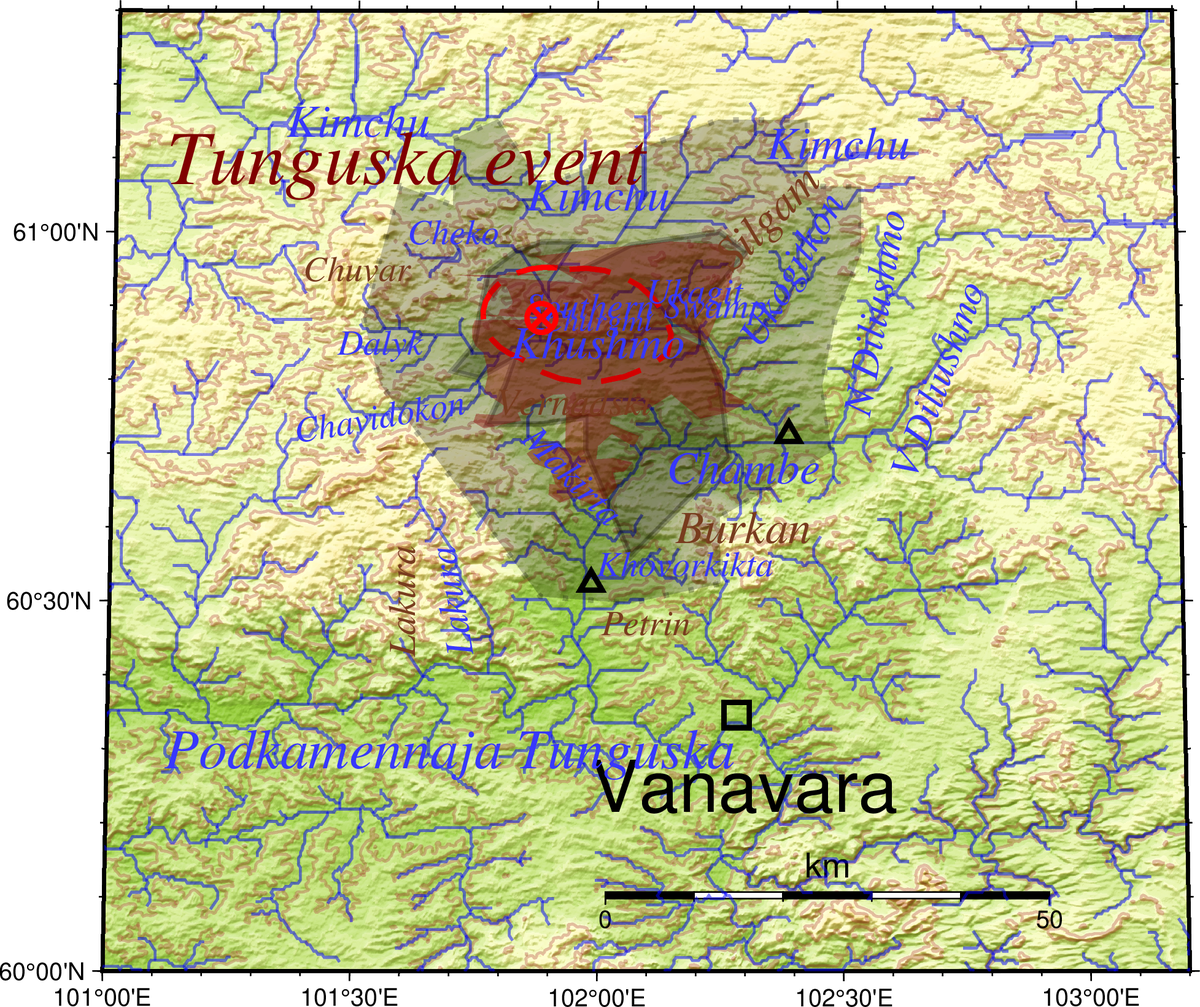
The Podkamennaya Tunguska River runs through the Evenkiysky District of central Siberia, a region of boreal forest so remote that the nearest railway was hundreds of kilometres away and the nearest permanent settlement was Vanavara, a trading outpost. There were no roads. In summer the land was bog and taiga; in winter it was passable only by sled. The local Evenki people lived across the region in widely scattered camps, following reindeer migrations through a wilderness that had no infrastructure and almost no contact with the Russian imperial state.
The event occurred above this landscape at 7:14 AM on June 30, 1908. It was a clear morning.
What the Instruments Recorded
The explosion registered on seismographs across Eurasia and was detected as a magnitude 5.0 earthquake equivalent. The atmospheric pressure wave it generated was recorded by barographs in Germany, Denmark, Croatia, the Dutch East Indies, and Washington, D.C. At Ditcham Park House in Hampshire, England, more than 5,600 kilometres from Siberia, a microbarograph captured a series of unusual air waves that circled the Earth twice before the instrument stopped recording them.
For three nights after the event, skies across Europe and western Asia were unusually luminous after dark. In Sweden and Scotland, people read newspapers outdoors at midnight by the light of the sky. Noctilucent clouds, seeded by water vapor thrown into the upper atmosphere by the explosion, are the suspected cause.
In regional Russian newspapers, brief accounts appeared in early July. The Sibir paper described "a strangely bright, impossible-to-look-at bluish-white heavenly body" followed by "a giant billow of black smoke." The Krasnoyaretz correspondent, writing from 150 kilometres away, described a noise "as if from a strong wind" followed by underground buzzing. No scientific investigation was organized. The Russian Empire had other concerns. The First World War was still six years away, the Revolution nine.
The Tunguska Event
Date: June 30, 1908, 7:14 AM local time
Location: Podkamennaya Tunguska River, central Siberia
Energy released: estimated 10–15 megatons (roughly 1,000 times the Hiroshima bomb)
Area flattened: 2,150 km² (830 square miles), 80 million trees
Pressure wave: detected in England, circled Earth twice
Human deaths: none confirmed; nearest settlement 65 km away
First scientific expedition: 1927 — nineteen years later
Nineteen Years to Get There
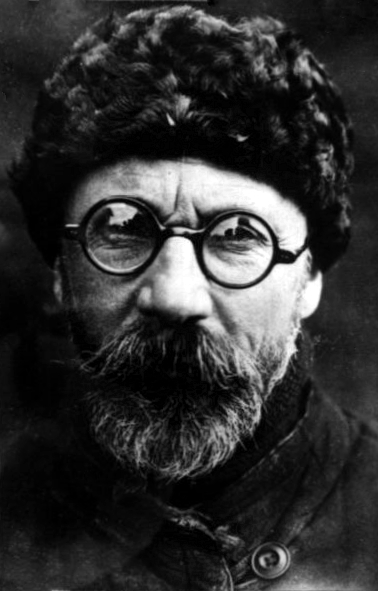
Leonid Kulik was a Russian mineralogist and meteorite specialist at the Soviet Academy of Sciences. In 1921, undertaking a survey of Siberian meteorite reports, he came across the accounts of the 1908 event and immediately recognized that something significant had struck the Earth. He spent six years raising funds and institutional support before mounting a proper expedition in 1927.
Getting to the site was itself an ordeal. Kulik's party traveled by rail to Kansk, then by horse-drawn sleigh, then on foot with reindeer as pack animals. The local Evenki guides refused to approach the epicenter, calling the area cursed. Kulik pressed on.
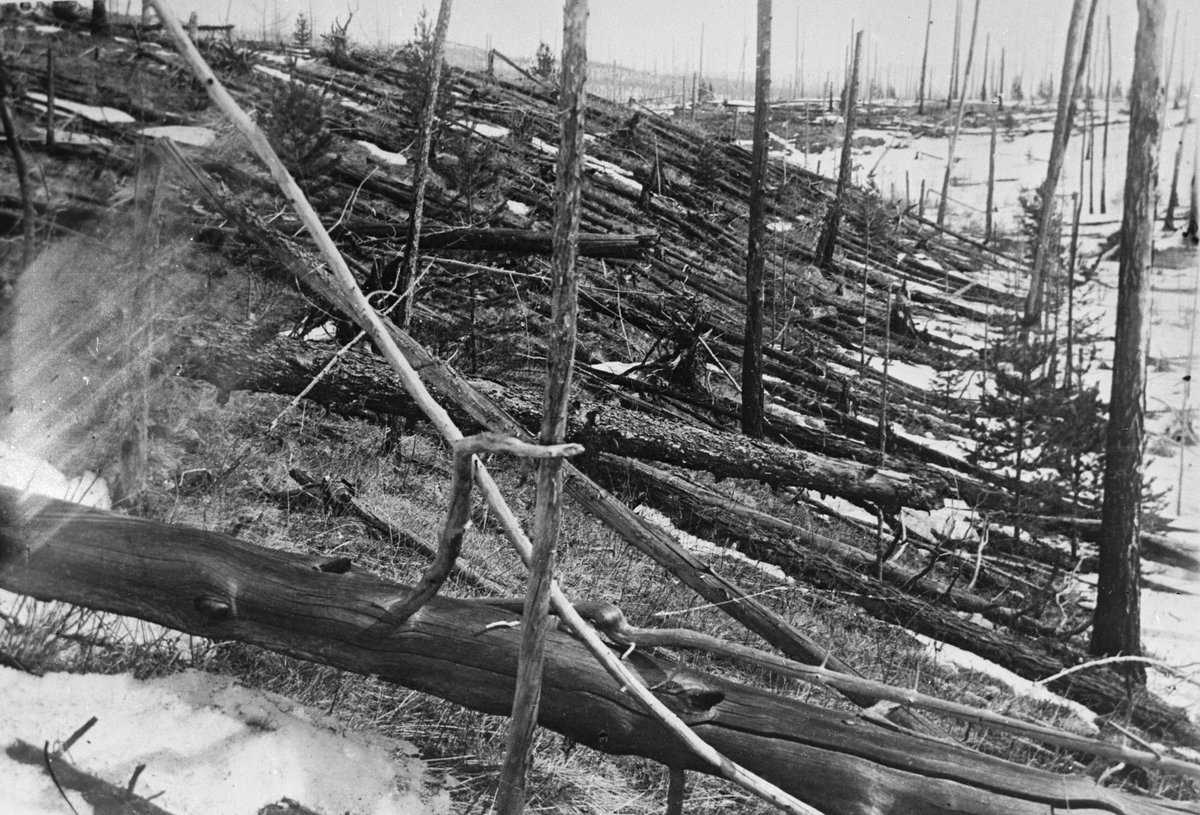
What he found was not what he expected. He had anticipated a large impact crater, possibly containing a massive iron meteorite worth considerable scientific and commercial value. Instead, he found a forest that had been catastrophically destroyed outward from a central point, with trees knocked flat in a radial pattern extending 30 kilometres in every direction, tops pointing away from the center. The pattern was unmistakable. Something had exploded above this place and the pressure wave had radiated outward from directly above.
The Telegraph-Pole Forest
At the center of the blast zone was something Kulik called the telegraph-pole forest. In a zone roughly eight kilometres across, the trees were still standing. But they had been stripped of every branch, every needle, every remnant of bark, reducing them to vertical poles that pointed at the sky. The overpressure from directly above had come down so forcefully that it had blasted the trees clean while leaving their roots in the ground.
There was no crater. Kulik searched extensively, found several dozen small circular bog depressions, and initially believed some might be meteorite fragment impact pits. He drained one, thirty-two metres in diameter, and found an old tree stump on the bottom. A natural bog feature, not an impact point. He mounted three more expeditions over the following twelve years, and in none of them did he find what he had come for. He died in German captivity in 1942, the mystery unresolved.
Why There Was No Crater
The absence of a crater is the key to understanding what happened. It tells you that whatever caused the explosion never reached the ground.
Modern atmospheric physics describes the mechanism as an airburst. A rocky body enters the atmosphere at high speed, typically 20 to 30 kilometres per second. As it descends into denser air, aerodynamic pressure builds against its leading face. If that pressure exceeds the structural strength of the rock before it reaches the surface, the object disintegrates explosively, releasing its energy not at a single impact point but across a volume of atmosphere. The resulting shockwave propagates outward and downward, hitting the ground from above and flattening everything below like a giant's fist pressing down from the sky.
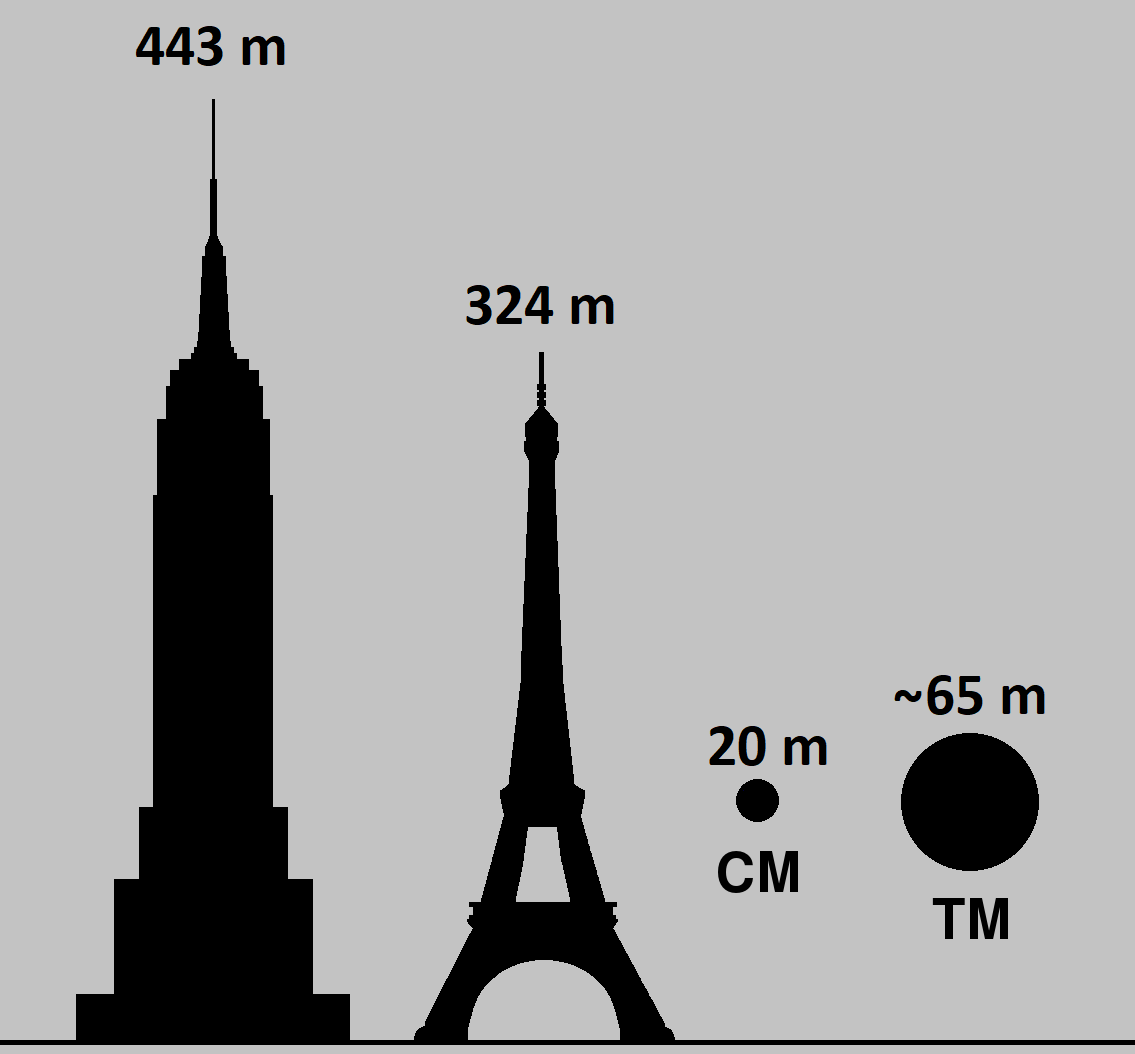
For a stony asteroid, this fragility threshold arrives relatively early. Iron meteorites are far more resistant and tend to reach the surface intact, forming craters. Stony bodies, especially at Tunguska's estimated size of 50 to 80 metres in diameter, often never make it. They explode at altitude, release their energy across thousands of square kilometres, and leave almost nothing recoverable on the ground. The asteroid essentially vaporizes. What survives is dust, submillimeter cosmic spherules recoverable only from peat bogs and lake sediments, and the physical record of the wave that passed through the forest.
What Actually Caused It
The scientific consensus, arrived at over several decades of modeling and analysis, is that the Tunguska event was caused by a stony asteroid 50 to 80 metres in diameter, entering the atmosphere at approximately 27 kilometres per second and exploding at an altitude of 5 to 10 kilometres above the surface. The energy released was between 10 and 15 megatons of TNT equivalent, roughly a thousand times the yield of the Hiroshima bomb. The asteroid was almost entirely vaporized by the explosion.
The competing hypotheses have largely been eliminated. The comet hypothesis, proposed by British astronomer F.J.W. Whipple in 1930, would explain the absence of fragments but cannot account for the microscopic meteoric spherules recovered from Tunguska peat bogs, which have the chemistry of asteroidal material. A 1973 proposal that the object was a primordial micro-black hole was formally refuted the following year: if a black hole had punched through the Earth, the exit shockwave should have been detectable somewhere in the North Atlantic, and no such record exists. Proposals involving antimatter, natural gas venting, and alien spacecraft have not produced evidence.
The 2013 Chelyabinsk meteor provided the clearest modern analogue. A 20-metre stony asteroid entered the atmosphere over Chelyabinsk, Russia, at 19 kilometres per second and exploded at roughly 30 kilometres altitude, releasing approximately 500 kilotons and injuring 1,500 people from windows shattered by the shockwave. Tunguska's impactor, at 50 to 80 metres versus Chelyabinsk's 20 metres, released roughly 20 to 60 times more energy. The mechanism was identical.
The Lake Cheko Question
In 2007, a team from the University of Bologna proposed that Lake Cheko, a small conical lake eight kilometres north-northwest of the epicenter, might be an impact crater left by a large fragment of the Tunguska object. The acoustic sonar profile of the lake floor was unusual. Magnetic readings hinted at a possible rock beneath the deepest point. The sediment core appeared to show a layer transition consistent with 1908.
The hypothesis attracted significant attention and was widely reported. It did not survive rigorous analysis. By 2017, Russian scientists had counted at least 280 annual sediment layers in the lake core, placing the lake's formation at a minimum of 280 years before the study, well before 1908. The earlier sediment-rate calculations had been contaminated by radioactivity from mid-twentieth-century nuclear weapons testing, which had caused the sedimentation rate to be overestimated by more than a factor of two. Geologists also noted that similar conical lake morphology is common in the same region of Siberian taiga as a result of permafrost thaw processes. The Lake Cheko crater hypothesis is now rejected.
In 2016, the United Nations designated June 30 as International Asteroid Day, the anniversary of the Tunguska event, to raise awareness about near-Earth objects. The choice of date was deliberate. Tunguska is the clearest demonstration in recent history that an asteroid capable of destroying a city has already struck the Earth, and that the only reason the death toll was zero was that it happened to strike one of the most uninhabited places on the planet.
The same object, arriving two hours later in the Earth's rotation, would have been directly above Saint Petersburg.
Works Cited
- Tunguska event — Wikipedia
- Tunguska event — Encyclopaedia Britannica
- 115 Years Ago: The Tunguska Asteroid Impact Event — NASA
- June 30, 1908: The Tunguska Event — American Physical Society
- What Is the Tunguska Explosion? — EarthSky
- I. M. Suslov (1926). Evenki eyewitness accounts of Chuchan and Chekaren, as reproduced in Wikipedia and secondary literature.
- S. B. Semenov account recorded by Leonid Kulik, 1930 expedition interviews.
- Jackson, A. A. & Ryan, M. P. (1973). Was the Tungus Event due to a Black Hole? Nature, 245, 88–89. Link
- Beasley, W. H. & Tinsley, B. A. (1974). Tungus event was not caused by a black hole. Nature, 250, 555–556. Link
- Chyba, C. F., Thomas, P. J., & Zahnle, K. J. (1993). The 1908 Tunguska explosion: atmospheric disruption of a stony asteroid. Nature, 361, 40–44.
- Leonid Kulik — Linda Hall Library, Scientist of the Day
- Tunguska event in fiction — Wikipedia