Every American school child learns about the Great Chicago Fire. Mrs. O'Leary's cow, the burning city, the 300 dead. It's one of the fixed points of 19th-century American history. What nobody mentions is that on the exact same night, in the forests of northern Wisconsin, a fire killed five times as many people and left almost no record at all.
The Peshtigo fire burned on October 8, 1871. It consumed 1.2 million acres, destroyed sixteen communities, and killed somewhere between 1,500 and 2,500 people — the range is that wide because the fire destroyed every record the town possessed, including the birth and death records that would have established exactly who was there. In Peshtigo itself, a lumber town of roughly 2,000 people, the fire killed nearly everyone.
It lasted about an hour.
A Town Built to Burn
Peshtigo, Wisconsin, in the autumn of 1871 was a company town that existed entirely because of wood. Chicago's first mayor, William Ogden, owned both the local sawmill and a woodenware factory that produced wooden dishes, tubs, and pails. The buildings were wood. The sidewalks were wood. The roads were paved with sawdust.
The surrounding forest was in a condition that, in retrospect, was less like a forest and more like a warehouse full of kindling. Logging operations had left slash across the ground in deep drifts: cut branches, bark, the tops of felled trees, piled and left to dry. Farmers burned stumps. Railroad engines threw sparks onto wooden ties. By autumn 1871, small fires had been smoldering for weeks across the region after one of the driest summers on record. The forest floor was not metaphorically tinder. It was literally tinder, with the moisture content of paper.
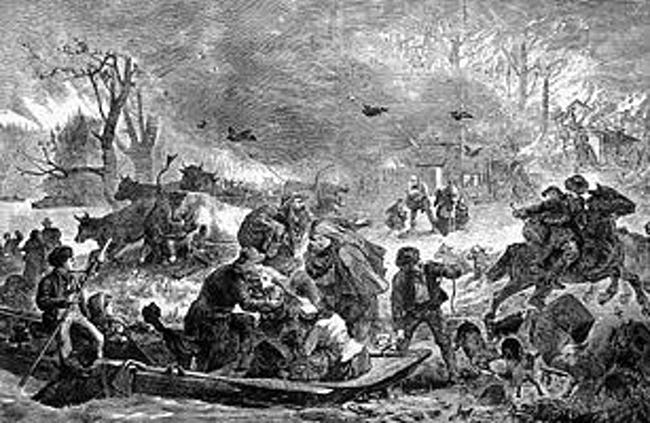
On the evening of Sunday, October 8, a cold front moved through the region from the west. Wind speeds jumped. The smoldering fires found the slash. What had been a slow regional smoke problem became something that didn't have a name yet in 1871.
What a Firestorm Actually Is
The fire that hit Peshtigo was not a wildfire in the ordinary sense. It was a firestorm: a fire so intense that it generates its own wind system, pulling air inward from all directions and sustaining the conditions that keep it alive. The physics are the same as the incendiary bombing of Dresden in World War II. The scale of destruction is comparable.
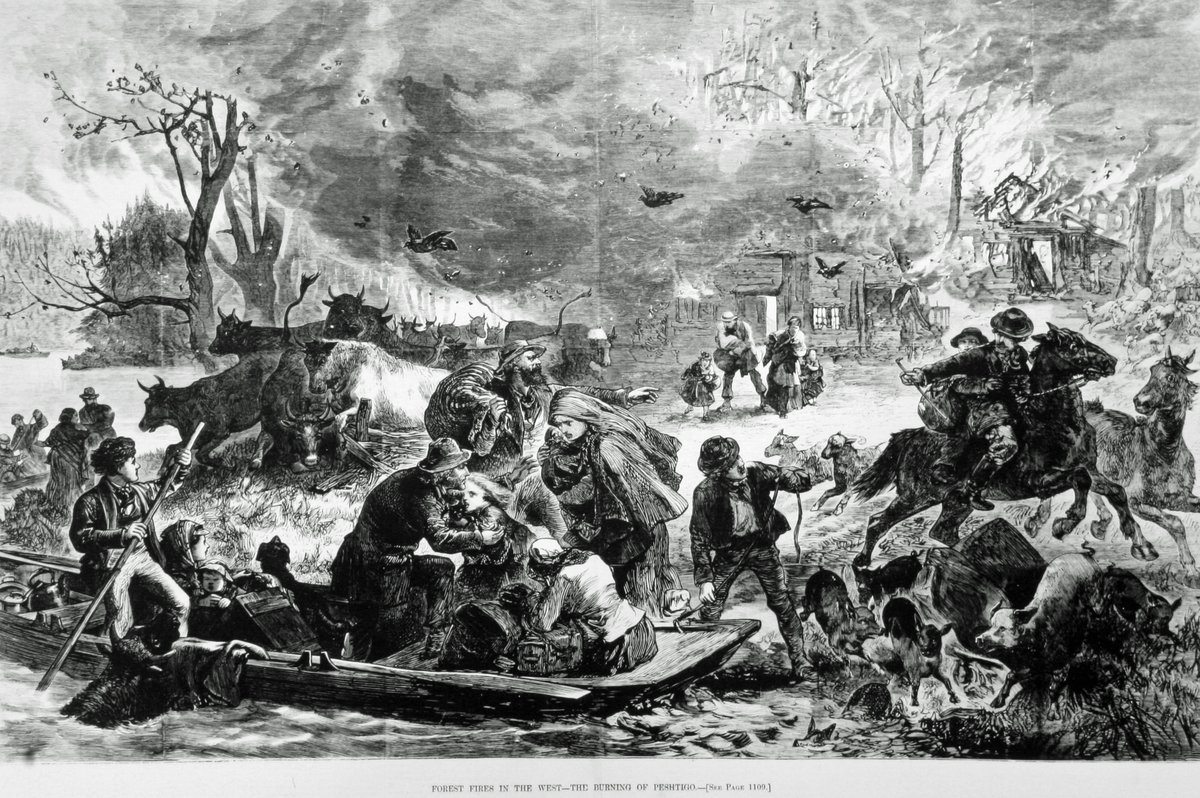
Father Peter Pernin, the Catholic priest who served Peshtigo and survived by wading into the Peshtigo River, wrote an account in 1874 that remains the most detailed eyewitness record of the event. He described first hearing "a distant roaring, yet muffled sound, announcing that the elements were in commotion somewhere." Then he looked up and saw, above the cloud of smoke, "a vivid red reflection of immense extent." Within minutes, the fire had arrived.
It moved at approximately 100 miles per hour. Interior temperatures reached at least 2,000 degrees Fahrenheit. The fire generated fire whirls, what we now call fire tornadoes, that survivors described lifting rail cars and houses and hurling them. In the community of Williamsonville, a single fire whirl consumed the entire settlement in minutes.
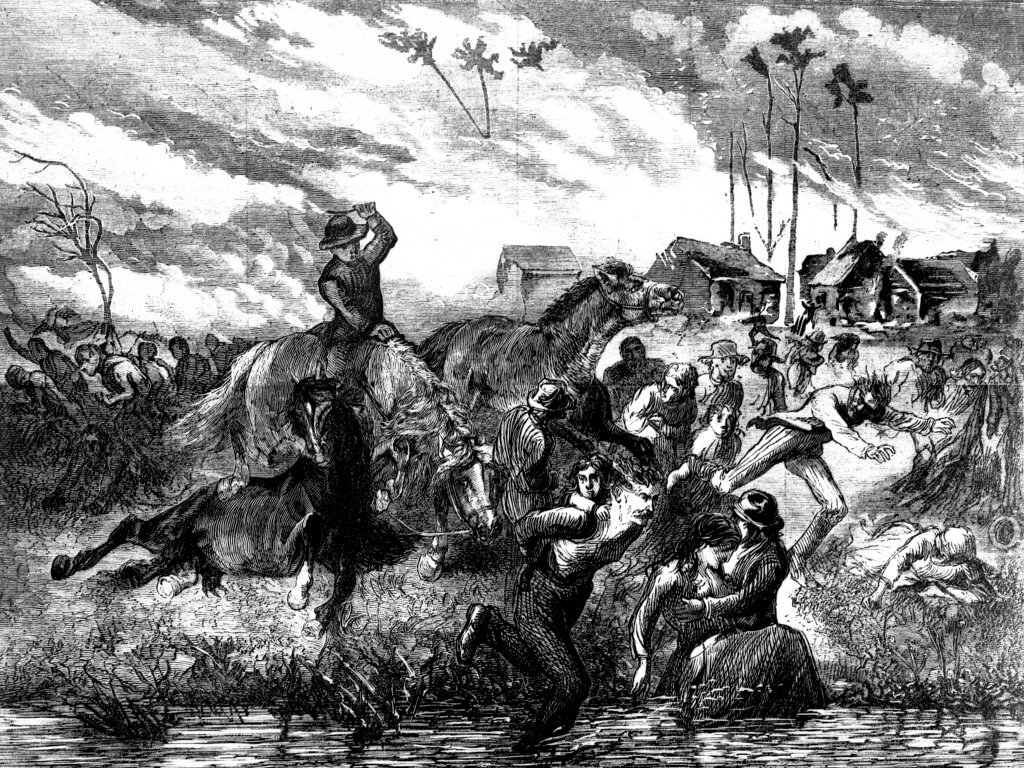
"The air itself was burning. Flames darted back and forth across the width of the river all night." — Father Peter Pernin, The Great Peshtigo Fire: An Eyewitness Account, 1874
People who could reach the Peshtigo River survived by entering the water and staying there through the night. They had to wet their heads and clothing continuously. If they stopped for even a brief interval, the fabric burst into flame. People who didn't reach the river largely didn't survive. Many were found in the road, caught while running. The fire overtook them in seconds.
The Scale
Area burned: 1.2 million acres across Wisconsin and Michigan
Communities destroyed: at least 16, including Peshtigo, Williamsonville, and parts of Michigan
Death toll: 1,500 to 2,500 — the range is wide because all local records burned
Unidentified dead in mass burial: approximately 350
Chicago fire, same night: approximately 300 dead
Duration: approximately one hour in Peshtigo proper
The Same Night as Chicago
Here is the fact that stops people: the Great Chicago Fire started on the same night. October 8, 1871. The same cold front, the same regional drought, the same conditions. Fires also broke out the same night in Holland, Michigan, Manistee, Michigan, and Port Huron, Michigan. All of them on October 8.
Some researchers have proposed a single cause for all of them: debris from Comet Biela, which had disintegrated in the 1860s and been replaced by a spectacular meteor shower. The theory points to eyewitness accounts of blue flames and simultaneous ignitions across a wide area. Mainstream science is skeptical. The wind shift from a single cold front, combined with months of accumulated slash across the entire region, provides a sufficient explanation without requiring an astronomical event. Blue flames are more simply explained by carbon monoxide combustion in enclosed structures. "Simultaneous ignition" accounts likely reflect the confusion of watching a 100-mph fire front in darkness and smoke.
The comet theory persists because the survivors' accounts strain the ordinary vocabulary of wildfire. They said fire fell from the sky. Some of them were probably describing burning embers travelling so fast ahead of the fire front that they appeared to fall vertically. But once that language is in the record, it's available to anyone looking for a more dramatic explanation.
Why Nobody Knows
The reasons the Peshtigo fire disappeared from history are straightforward and somewhat grim.
Chicago had 300,000 people, telegraph lines, newspapers, and war correspondents who knew how to file a story from a disaster. Peshtigo had 2,000 people, no photographers, and no record of who had been there. The fire destroyed the birth and death registers, the church records, the mill records. When reporters finally arrived days later, Chicago had already consumed the national press cycle. The Peshtigo fire received a small notice in the New York Times. Chicago received the front page for weeks.
William Ogden, whose sawmill and factory drove Peshtigo's existence, also owned significant Chicago real estate. His political energy and legal resources went toward Chicago's reconstruction. Wisconsin's governor didn't visit the burned region for days after the fire. No one was held accountable for the logging practices that had turned the forest floor into a prepared fuel bed. The lumber industry continued essentially unchanged.
Father Pernin wrote explicitly about "human carelessness" as a cause equal to the drought. He meant the decades of slash accumulation, the routine burning of fields, the sparks from railroad engines that everyone had come to accept as normal. The conditions that produced the Peshtigo fire were not an act of God. They were the predictable result of treating a forest as an infinite fuel depot and leaving the waste on the ground.
Today Peshtigo has roughly 3,500 residents. There is a small fire museum west of Highway 41, with artifacts, first-person accounts, and a graveyard for fire victims. A mass burial site in the town holds the remains of approximately 350 people who were never identified. A memorial at the bridge over the Peshtigo River was dedicated on October 8, 2012, the 141st anniversary of the fire.
The river is still there. So are the forests. So is the slash.
Works Cited
- Peshtigo fire — Wikipedia
- How the 1871 Peshtigo Fire Became America's Deadliest Wildfire — History.com
- The Peshtigo Fire — NOAA National Weather Service Green Bay
- The Peshtigo Fire — Wisconsin State Climatology Office
- Peter Pernin, The Great Peshtigo Fire: An Eyewitness Account — University of Wisconsin Digital Collections
- Great Fires of 1871 — Wikipedia
- Peshtigo Fire Museum