The name "Jack the Ripper" was almost certainly invented by a journalist. The "Dear Boss" letter that introduced it — sent to the Central News Agency in September 1888 — was in all likelihood written by a reporter who wanted to sell papers, and in 1931 a journalist named Fred Best was reported to have said exactly that. The name stuck anyway. It's been stuck for 136 years.
This is one of the things worth knowing about the Ripper case before you start: a significant portion of what most people believe about it is either newspaper invention, later embellishment, or the accumulated mythology of a hundred years of true crime publishing. Peeling it back to what's actually in the evidence leaves you with something more genuinely puzzling, and more human, than the gothic legend.
The Place and the Five
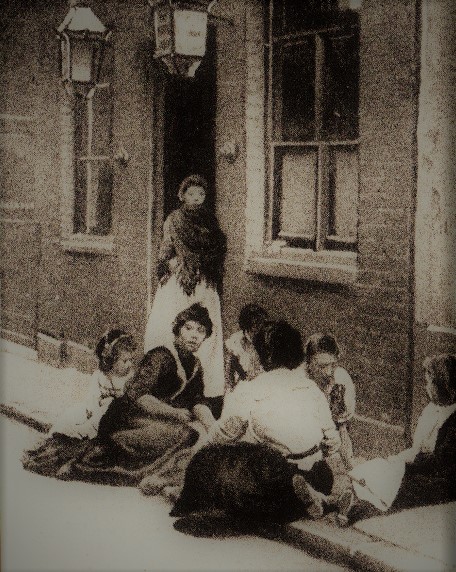
Whitechapel in 1888 was one of the most densely packed places in the world: roughly 200 people per acre, against London's average of 45. In less than a square mile, crumbling tenements, slaughterhouses, sweatshops, and common lodging houses pressed together. The women who were killed had all been reduced, by the economics of extreme poverty, to sleeping in lodging houses where a bed for the night cost four pence and could be paid for in only one reliable way.
The five canonical victims are called canonical not because police determined they formed a definitive group, but because researchers later agreed they showed the strongest evidence of a single perpetrator. The Whitechapel murders file actually covered eleven deaths between 1888 and 1891.
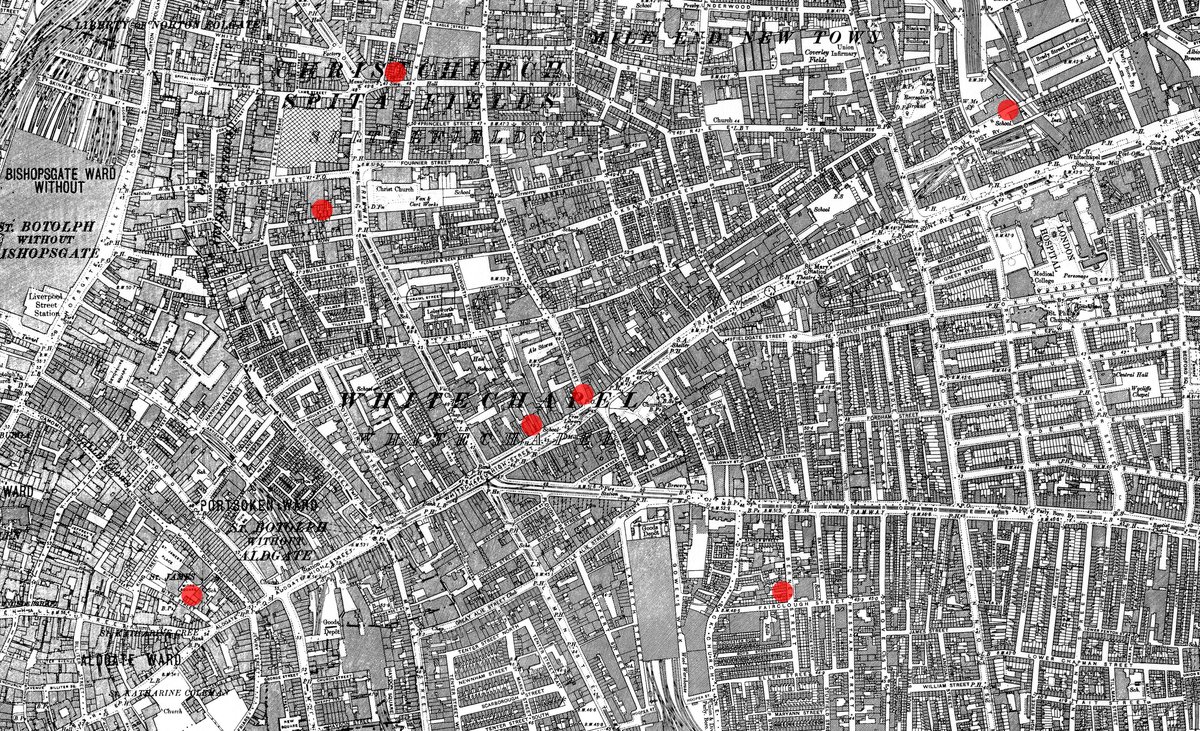
Mary Ann Nichols, August 31. Throat cut twice, abdomen severely mutilated. Found in Buck's Row.
Annie Chapman, September 8. Throat severed. Her uterus had been surgically removed in what the pathologist described as a single, clean cut with a blade six to eight inches long. He told the inquest the killer possessed anatomical knowledge. Other medical witnesses disputed this.
Elizabeth Stride and Catherine Eddowes, September 30 — the double event. Stride was found with only her throat cut, possibly interrupted. Eddowes, less than an hour later and half a mile away, had been extensively mutilated; her left kidney and part of her uterus were removed and taken.
Mary Jane Kelly, November 9. The only canonical victim murdered indoors, in her single rented room. Because the killer was unobserved and had time, Kelly's body sustained approximately two hours of mutilation. Her heart was removed. It was never found. These murders stopped after November 9.
The Investigation
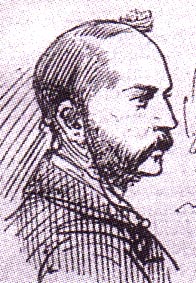
Inspector Frederick Abberline was the lead detective on the ground. He had served fourteen years in the East End before being transferred to Scotland Yard and was brought back specifically because he knew the neighborhood and its people. By his own account the volume of statements, tips, and false confessions was overwhelming. He later said: "Scotland Yard is really no wiser on the subject than it was fifteen years ago."
The investigation was limited by its era in ways that can't be overstated. No fingerprinting: Henry Faulds had written about the possibility in 1880, but Scotland Yard didn't adopt the technique until 1901. No blood typing. No DNA. Crime scenes were not preserved. The public walked through them. When a piece of Catherine Eddowes's apron was found near a chalked message on a Goulston Street wall, Metropolitan Police Commissioner Charles Warren ordered the message erased before it could be photographed — apparently to prevent anti-Jewish violence. Whether the message had anything to do with the killer, nobody can now determine.
The One Letter Worth Taking Seriously
During the autumn of 1888, hundreds of letters flooded police stations claiming to be from the killer. Nearly all are dismissed as obvious hoaxes, including the famous "Dear Boss" letter that named "Jack the Ripper" and the "Saucy Jacky" postcard. Both were written in the same hand, with a theatrical flair that reads more like a newspaper correspondent than a murderer.
The "From Hell" letter is different.
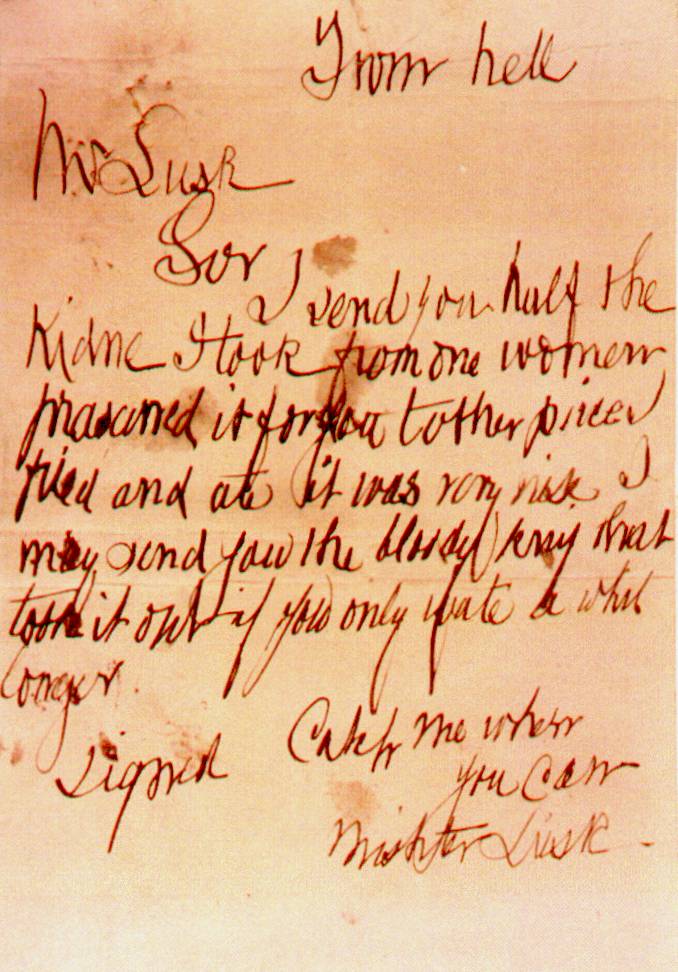
It was sent on October 16, 1888, not to the police or a newspaper but to George Lusk, a civilian who headed the Whitechapel Vigilance Committee. It arrived with half a preserved human kidney. The letter was poorly spelled, barely literate, and had none of the theatrical flair of the "Dear Boss" correspondence. The handwriting is entirely different. It didn't seem to be performing for an audience.
A physician at the London Hospital examined the kidney. It appeared to be from a woman around 45 years old — Catherine Eddowes had been 46. It showed signs of Bright's disease. The letter claimed the sender had fried and eaten the other half. Whether that detail is true is not determinable.
Most serious Ripper researchers consider the "From Hell" letter the only piece of correspondence with a reasonable chance of being authentic, precisely because it lacks the showmanship of everything else.
The Main Suspects
Montague Druitt — barrister and schoolteacher; body found in Thames, December 1888; no physical evidence
Aaron Kosminski — Polish-born barber; admitted to a lunatic asylum 1891; named in police memoranda
Francis Tumblety — American quack doctor; arrested London, November 7, 1888; fled to France before Kelly's murder; Scotland Yard pursued him to New York
Walter Sickert — painter; theory pursued extensively by crime writer Patricia Cornwell; largely rejected by researchers
The DNA Study That Didn't Solve It
In 2019, a peer-reviewed paper in the Journal of Forensic Sciences claimed that mitochondrial DNA from a shawl allegedly found at the Eddowes scene matched descendants of both Eddowes and suspect Aaron Kosminski. It attracted enormous press coverage. It was not, in any meaningful sense, a solution.
The problems begin with the shawl itself: there is no contemporaneous documentation placing it at the crime scene in 1888. Chain of custody is unverifiable. More fundamentally, mitochondrial DNA is inherited through the maternal line and is not individual-specific. The same sequence could match tens of thousands of people who shared the same maternal ancestry in 19th-century London. Hansi Weissensteiner of Innsbruck Medical University stated explicitly that mitochondrial DNA analysis can show people are not related but cannot confirm identity. The journal subsequently published a formal Expression of Concern about the paper, noting methodological errors.
Abberline said Scotland Yard was no wiser fifteen years later. The same is true today.
What's Genuinely Unknown
The mystery of Jack the Ripper is usually framed as a question of identity. Who was he? That framing obscures how much else we don't know.
We don't know the definitive victim count. The "canonical five" is a scholarly convention, not a police determination. The Whitechapel murders file covered eleven deaths. Whether all eleven share a perpetrator, or the five, or some other number, is genuinely open.
We don't know whether the killer had surgical training. The pathologist's testimony about anatomical skill was disputed by other medical witnesses at the same inquest. He could equally have been a butcher, a slaughterman, or simply someone who was confident and unhurried.
We have no confirmed written communication from the killer. Only one letter that might be real, sent to a committee secretary, written in the handwriting of someone who could barely spell.
What we do know is the context: five women killed in extreme poverty in a half-square-mile of the most crowded city on Earth, in a place where violence was ordinary and the police were overextended and the forensic tools of the modern era did not yet exist. The mystery survived not because the killer was supernatural or uniquely clever, but because the conditions of 1888 Whitechapel made him effectively invisible from the moment he stepped back into the crowd.
Works Cited
- Jack the Ripper — Wikipedia
- Jack the Ripper suspects — Wikipedia
- From Hell letter — Wikipedia
- Dear Boss letter — Wikipedia
- Does new genetic analysis reveal the identity of Jack the Ripper? — Science/AAAS
- Jack the Ripper: A Wrongful Conviction Based on Flawed DNA Analysis — Newswise
- New evidence points to old Jack the Ripper suspect, but here is why I'm not convinced — The Conversation
- The Ripper Letters — Whitechapel Jack