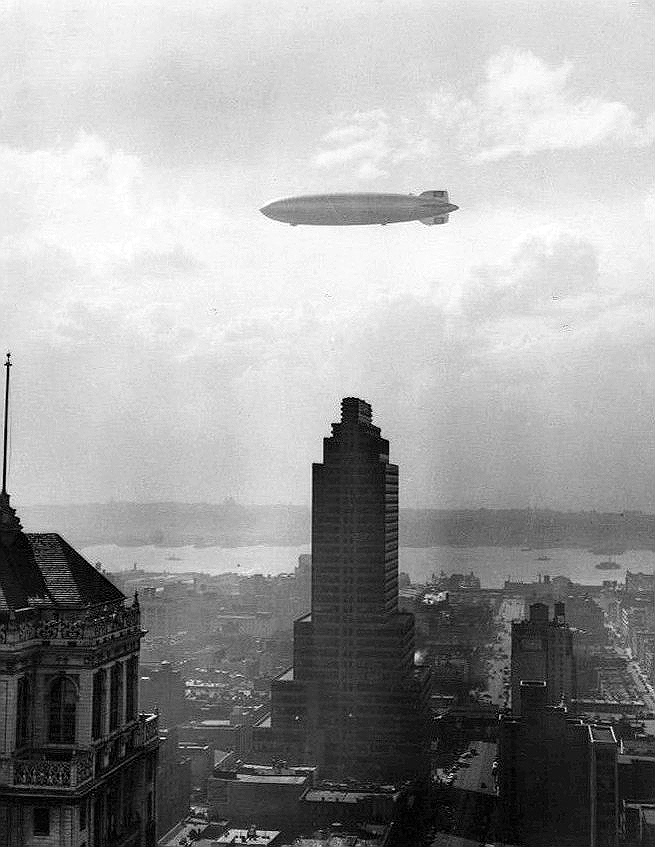
The Hindenburg measured 245 metres long — roughly the height of an 81-storey building laid on its side — and 41 metres in diameter. It was built by Luftschiffbau Zeppelin in Friedrichshafen and flew its maiden test flight on March 4, 1936. Alongside its sister ship the LZ 130, it remains the largest flying object ever constructed.
In its 1936 operating season, it completed 17 transatlantic crossings: 10 to the United States, 7 to Brazil, carrying 2,798 passengers and covering 308,323 kilometres. The fastest Atlantic crossing was 45 hours and 39 minutes eastbound. Ocean liners took five days. A one-way fare between Frankfurt and New York cost $400 — roughly $9,000 in today's money — and the passengers who paid it were treated to a dining room with proper linen and crystal, promenade windows angled to give unobstructed downward views of the ocean, and cabin service of a standard that no aircraft before or since has matched.
The Hydrogen Question
The Hindenburg was designed to fly on helium. The engineers at Luftschiffbau Zeppelin understood hydrogen's danger. Their intention, before the first panel of hull was built, was to approach the United States government for an export license. Helium was extractable in industrial quantities almost exclusively from American oil fields, and a National Helium Reserve had been established under military control.
The application was refused. The Helium Control Act of 1927 classified helium as a strategic mineral resource and prohibited its export. The US government was not prepared to provide the lifting gas that would make a Nazi propaganda airship fly. The Zeppelin engineers redesigned the ship for hydrogen.
Hydrogen burns. The flammability range of hydrogen in air runs from 4 to 75 percent by volume — a wide, unforgiving band. Helium, being inert, does not burn at all. The switch from one to the other was not a calculation that the designers made freely.
LZ 129 Hindenburg
Length: 245 metres (803 ft) — largest flying object ever built
Lift gas: hydrogen (16 cotton gas bags, 200,000 m³ total volume)
Engines: four Daimler-Benz V-16 diesel, 1,200 hp each
Passengers, final voyage: 36
Crew, final voyage: 61
Fire ignition: 7:25 PM EDT, May 6, 1937
Time to destruction: approximately 34 seconds
Deaths: 36 (13 passengers, 22 crew, 1 ground worker)
Survivors: 62 of 97 aboard
The Ship as Propaganda
The Hindenburg was not simply a commercial carrier. Hermann Göring had established the Deutsche Zeppelin Reederei — the operating company — in 1935, with the German Air Ministry as a co-owner, specifically to increase Nazi political control over the Zeppelin program. The two large swastika markings on the tail fins were placed there as part of a funding arrangement with the Nazi Party.
Hugo Eckener, the Zeppelin Company's chairman and the most respected figure in world airship history, privately despised the regime. Propaganda Minister Goebbels had banned all mention of Eckener's name in German newspapers after Eckener refused to endorse Hitler in a 1936 referendum. When the Hindenburg was pressed into service as a propaganda vehicle for the Rhineland remilitarization — flying over Germany for four days broadcasting political speeches from loudspeakers, dropping leaflets — Eckener refused to command the flight.
The 34 Seconds
The Hindenburg had been scheduled to arrive at Lakehurst in the early afternoon of May 6. Thunderstorms delayed the approach. Captain Max Pruss held the ship along the New Jersey coastline, passing over Manhattan, waiting for the weather to clear. The final approach began around 7 PM, in difficult crosswind conditions.
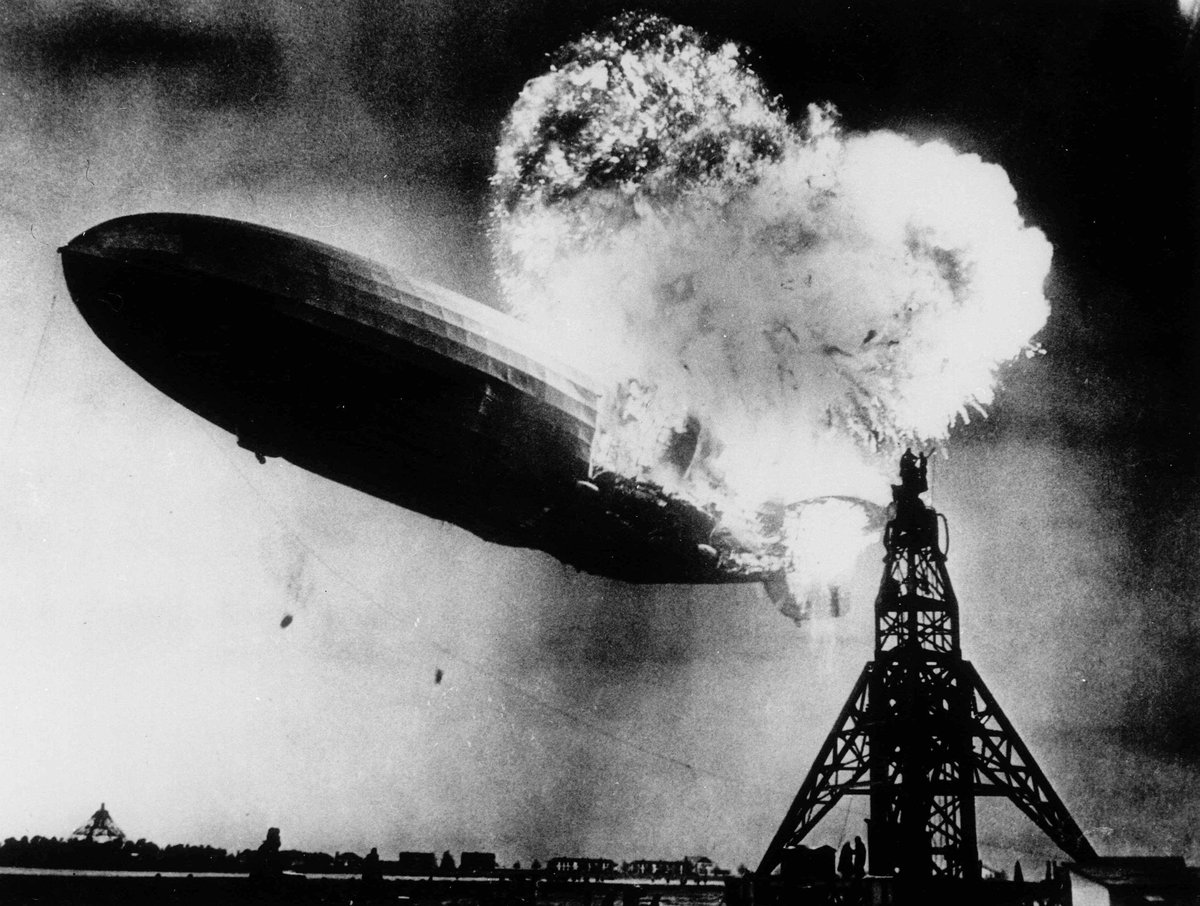
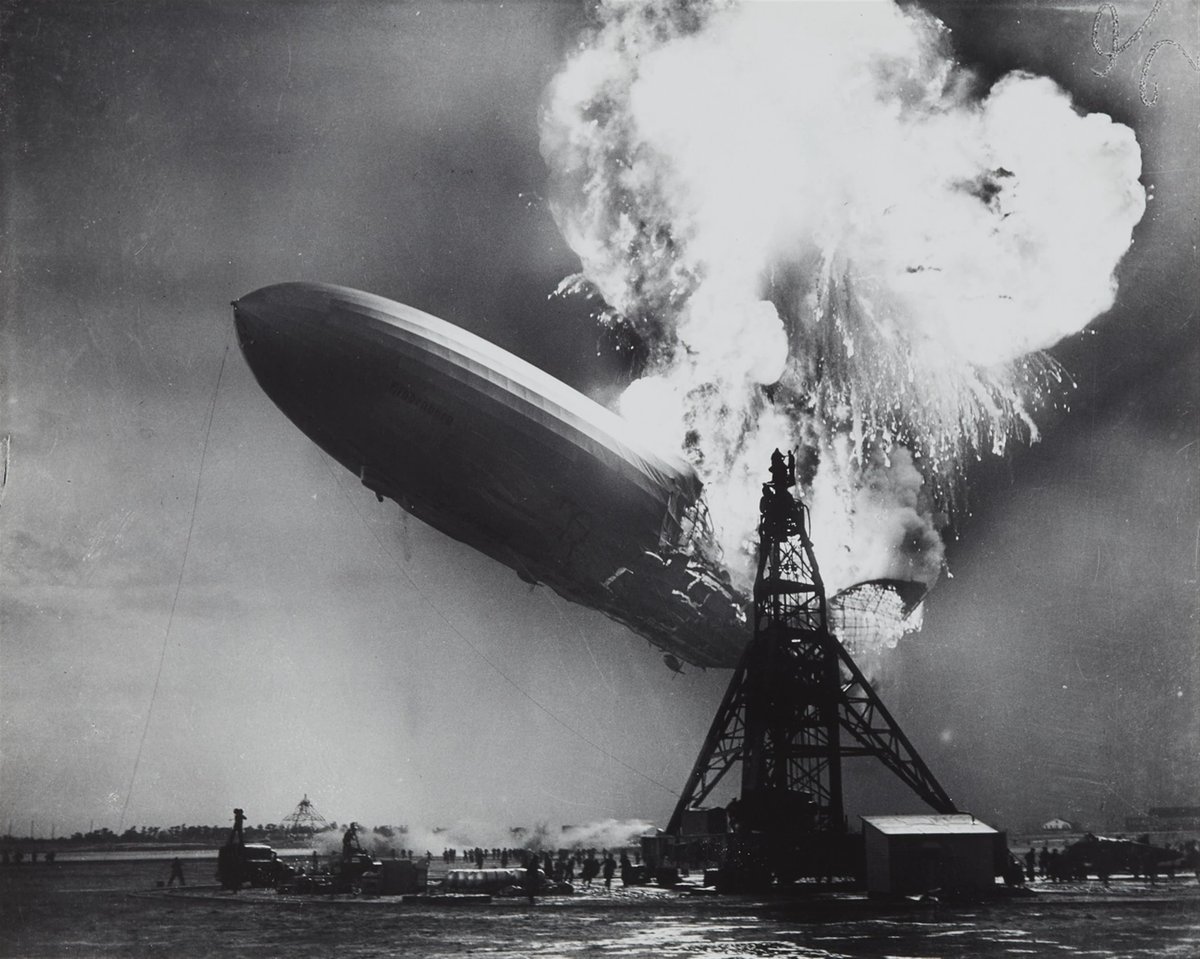
At 7:21 PM, the mooring lines were dropped from 295 feet. At 7:25 PM, witnesses watching from the ground observed a pale reddish or blue glow near the upper tail fin, in the region of gas cells 4 and 5. Within seconds the aft section was fully involved.
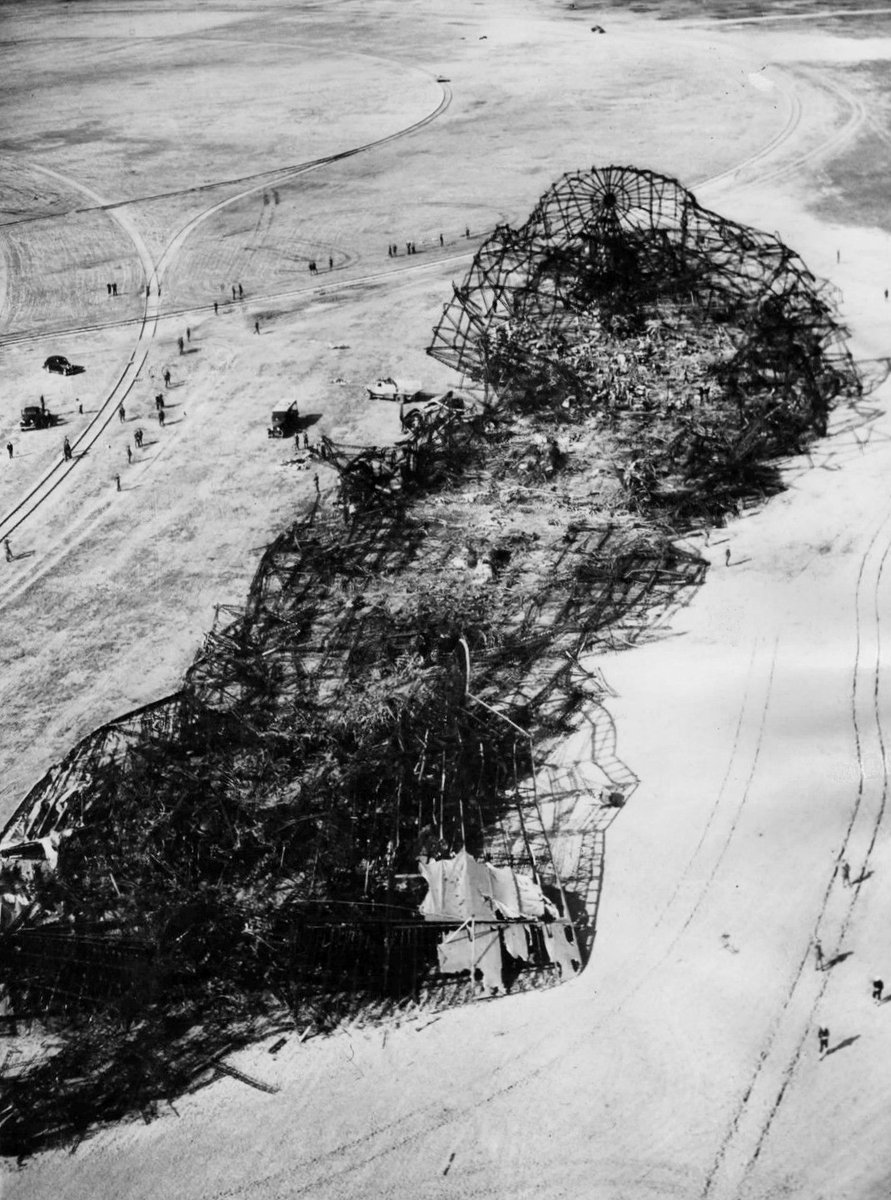
The fire moved forward through the ship as hydrogen cells ruptured in sequence. The stern fell first. The bow, briefly buoyed by cells not yet consumed, lurched upward at approximately 45 degrees before its cells ignited and it collapsed to the ground. From first visible flame to the bow touching the ground: approximately 34 seconds.
Sixty-two of 97 people aboard survived. This number surprises people who know only the footage and Herbert Morrison's voice. The survival rate of 64 percent demands explanation.
Several factors converged. The ship burned from the tail forward, giving passengers in forward sections additional seconds. The bow's temporary upward rise allowed crew members in that section to drop or jump before it collapsed. A crosswind pushed flames toward the starboard side, leaving the port side with a clearer escape route. A 14-year-old cabin boy named Werner Franz survived when a water ballast tank burst overhead and drenched him, extinguishing the flames long enough for him to drop through a hatch. The ship did not explode as a unified detonation. People fell with a collapsing open lattice structure, not inside a sealed fuselage.
Herbert Morrison's Recording
Herbert Morrison was 31 years old and working for WLS Chicago when American Airlines contacted the station requesting coverage of the Hindenburg landing. He volunteered. His sound engineer Charles Nehlsen operated a Presto Direct Disc recorder — a transcription machine that cut audio into lacquer discs — because there was no live broadcast circuit at Lakehurst. Morrison was not on air. He was documenting the event for later playback.
When the fire started, he kept recording. His full statement, as preserved on the lacquer discs, was: "Oh, the humanity and all the passengers screaming around here!" The commonly quoted version omits the second half. He believed, in that moment, that no one had survived.
WLS aired his full report in Chicago the following day at 12:45 PM. NBC then broadcast an excerpt — breaking its standing policy against pre-recorded material, the first time the network had ever done so. The original discs are now held in the Special Media Archives at the National Archives.
What Morrison recorded in 37 minutes of material is not only the famous moment of rupture but a composed, professional account of the wreckage, the survivors, the emergency response. He recovered his composure within seconds. He later told colleagues he hoped "it isn't as bad as I made it sound at the very beginning."
The Cause: Four Theories, One Fire
Neither the American Bureau of Air Commerce investigation nor the German Reich Air Ministry investigation reached a finding supported by direct physical evidence. Both concluded that an electrostatic discharge ignited a hydrogen leak in the tail section — but the joint report's own language acknowledged that this rested on two unproven coincidences occurring simultaneously.
The electrostatic theory holds that the Hindenburg's outer cotton skin was electrically isolated from its duralumin frame by non-conductive lacing cord. The ship had passed through a thunderstorm-charged atmosphere. When the mooring lines were dropped, they initially ran dry and grounded the metallic frame but not the skin. When the lines became wet — minutes later — they suddenly grounded the skin, discharging the potential difference between skin and frame as a spark. Princeton physicist Professor Mark Heald, watching from the ground, reported seeing a dim blue flickering along the backbone girder approximately 60 seconds before the fire became visible. A 2021 PBS Nova investigation in collaboration with Caltech's Dr. Konstantinos Giapis produced experimental confirmation that rain activation was a necessary component of the discharge mechanism — dry skin was non-conductive and would not have produced the spark.
In the 1990s, retired NASA engineer Addison Bain proposed a different primary cause: the outer skin itself. The cotton doping compound contained cellulose acetate butyrate with aluminum and iron oxide — compounds Bain described as chemically analogous to rocket propellant. He argued the visible orange-red flames were characteristic of a burning fabric, not a hydrogen fire, which burns with a nearly invisible pale blue flame. His hypothesis attracted serious attention and was the subject of a documentary and a History Channel production.
The engineering counter-case is detailed. Alexander J. Dessler of NASA Marshall Space Flight Center and colleagues published a refutation in 2005: burn-rate calculations showed that the skin doping compound alone, at any plausible concentration, would have taken approximately 40 hours to consume the ship — not 34 seconds. Laboratory tests of replica outer covering confirmed cellulose acetate butyrate's classification as a self-extinguishing material. Sections of tail fin covering survived the fire, inconsistent with an explosive doping compound. Newsreel footage and crew testimony reported a glow inside gas cell 4 before external flames were visible, indicating internal ignition. The mainstream aeronautical history community has not accepted Bain's hypothesis. The Smithsonian's National Air and Space Museum endorses hydrogen ignition as the primary cause.
A third possibility was raised — and then partly suppressed — in the joint investigation: structural failure. Lieutenant Benjamin May, the Assistant Mooring Officer at Lakehurst, testified that the port flank appeared to "collapse outwardly" before any flames were visible, and that he heard metal cracking. His testimony was excluded from the published final report. Hugo Eckener privately concluded that Captain Pruss's rushed approach under difficult crosswind conditions had imposed excessive torsional stress on the aft section, and that bracing wires and frame in the tail region may have failed before any ignition occurred.
Sabotage was the fourth theory — raised by Eckener himself in his first phone call on the night of the disaster, then withdrawn. The formal version named Erich Spehl, a 26-year-old rigger who died in the fire. Spehl's duty station was near the point of origin; his girlfriend had anti-Nazi connections. No physical evidence of a device was ever recovered. The Gestapo investigated. Nothing was proven. In 2015, investigative journalist Eric Brothers published a detailed examination arguing that anti-Nazi crew members had motive, means, and opportunity. The hypothesis remains unproven and unprovable.
The LZ 130 Graf Zeppelin II, the Hindenburg's sister ship, completed 30 flights after the disaster but was never placed in commercial passenger service. In 1940, Hermann Göring ordered both the LZ 130 and the original LZ 127 Graf Zeppelin scrapped, their duralumin frameworks recycled into Luftwaffe aircraft.
The psychological impact of Morrison's recording far exceeded the disaster's actual casualty figures. Contemporary airline crashes killed comparable numbers with far less coverage. The 64 percent survival rate was not particularly unusual for aviation accidents of the era. But "Oh, the humanity" played hundreds of times on American radio, and the image of the burning ship was on every front page in the world. The age of passenger rigid airships, which had lasted barely two decades as a commercial proposition, was over.
The cause of the fire has never been proven beyond the testimony of people who watched from the ground and a set of lacquer discs recorded by a man who believed, in that moment, that everyone was dead.
Works Cited
- U.S. Department of Commerce, Bureau of Air Commerce (1937–1938). Investigation Report: Hindenburg Accident. National Archives.
- Reichsluftfahrtministerium (1938). Report on the Hindenburg Accident. Published January 1938.
- Dick, H.G. & Robinson, D.H. (1985). The Golden Age of the Great Passenger Airships: Graf Zeppelin and Hindenburg. Smithsonian Institution Press.
- Bain, A. (1997). Hydrogen Flames. IEEE Technology and Society Magazine.
- Dessler, A.J. et al. (2005). The Hindenburg Hydrogen Fire: Fatal Flaws in the Addison Bain Incendiary-Paint Theory. Full paper (PDF)
- Eckener, H. (1958). My Zeppelins. (Trans. from German.)
- National Archives. Herbert Morrison recordings. Special Media Archives, Donated Materials. Archives.gov
- Library of Congress National Recording Preservation Board. Hindenburg recording document (PDF)
- PBS Nova / Caltech (2021). "Hindenburg: The New Evidence." Documentary. Caltech Dr. Konstantinos Giapis's experimental confirmation of the rain-activation electrostatic discharge mechanism.
- Hoehling, A.A. (1962). Who Destroyed the Hindenburg? Little, Brown. First formal presentation of the Spehl sabotage hypothesis.
- Brothers, E. (2015). Hindenburg Sabotage. Detailed examination of the anti-Nazi crew motivation and the sabotage timeline.
- Shirer, W.L. (1941). Berlin Diary. Alfred A. Knopf. Contemporaneous CBS Berlin correspondent account; includes Eckener's conflict with Goebbels.