A Ridge in the Foothills
Göbekli Tepe sits on a limestone ridge in the Taurus mountain foothills of southeastern Turkey, approximately 15 kilometres northeast of the city of Şanlıurfa in the province of the same name. The elevation is 760 metres. From the top of the ridge, the surrounding plain spreads in every direction — flat, pale, and largely empty. There are no rivers nearby. There are no obvious resources. The place was chosen, it seems, for the view.
The site was first noted in 1963 during a joint survey by anthropologists from the University of Chicago and Istanbul University. The survey team found carved limestone slabs scattered across the hilltop and noted them in their records. The slabs were classified as medieval grave markers. The survey moved on. For the next three decades, Göbekli Tepe sat in the literature as an unremarkable hill with some broken stone.
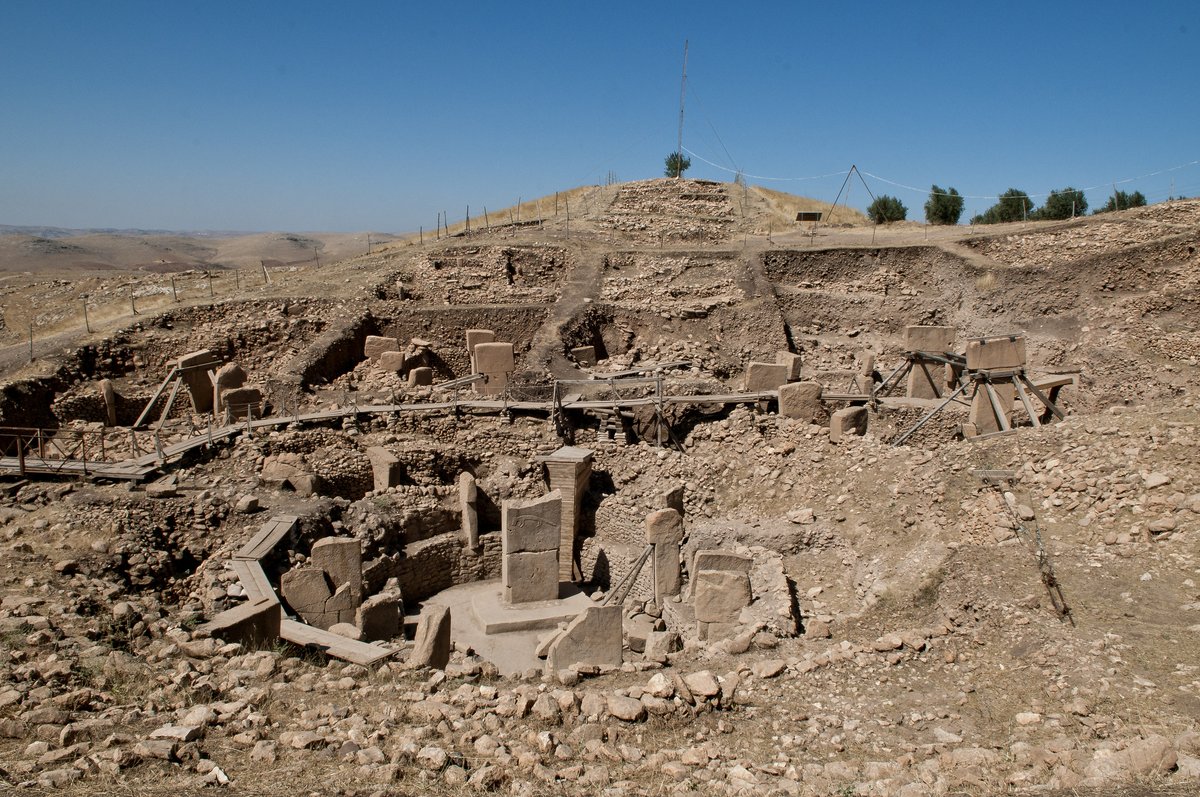
In October 1994, a German archaeologist named Klaus Schmidt arrived to look at the site. Schmidt had been working nearby at Nevalı Çori, a Pre-Pottery Neolithic site that had produced T-shaped pillars similar to those described, and largely dismissed, in the 1963 survey notes. He recognised immediately that what the survey had called medieval grave markers were something else entirely: the tops of monumental limestone pillars, still partially buried, of a kind that had no parallel in the known archaeological record.
Schmidt began systematic excavation in 1995. He would continue directing the work at Göbekli Tepe until his death in 2014, twenty years after he first walked up that ridge.
What the Excavation Found
The scale of what lay beneath the surface took years to emerge. Ground-penetrating radar and geomagnetic surveys, carried out alongside the excavations, eventually mapped at least twenty circular or oval enclosures distributed across the hilltop. As of 2024, six have been excavated to any meaningful degree. The rest remain underground, where the builders left them.
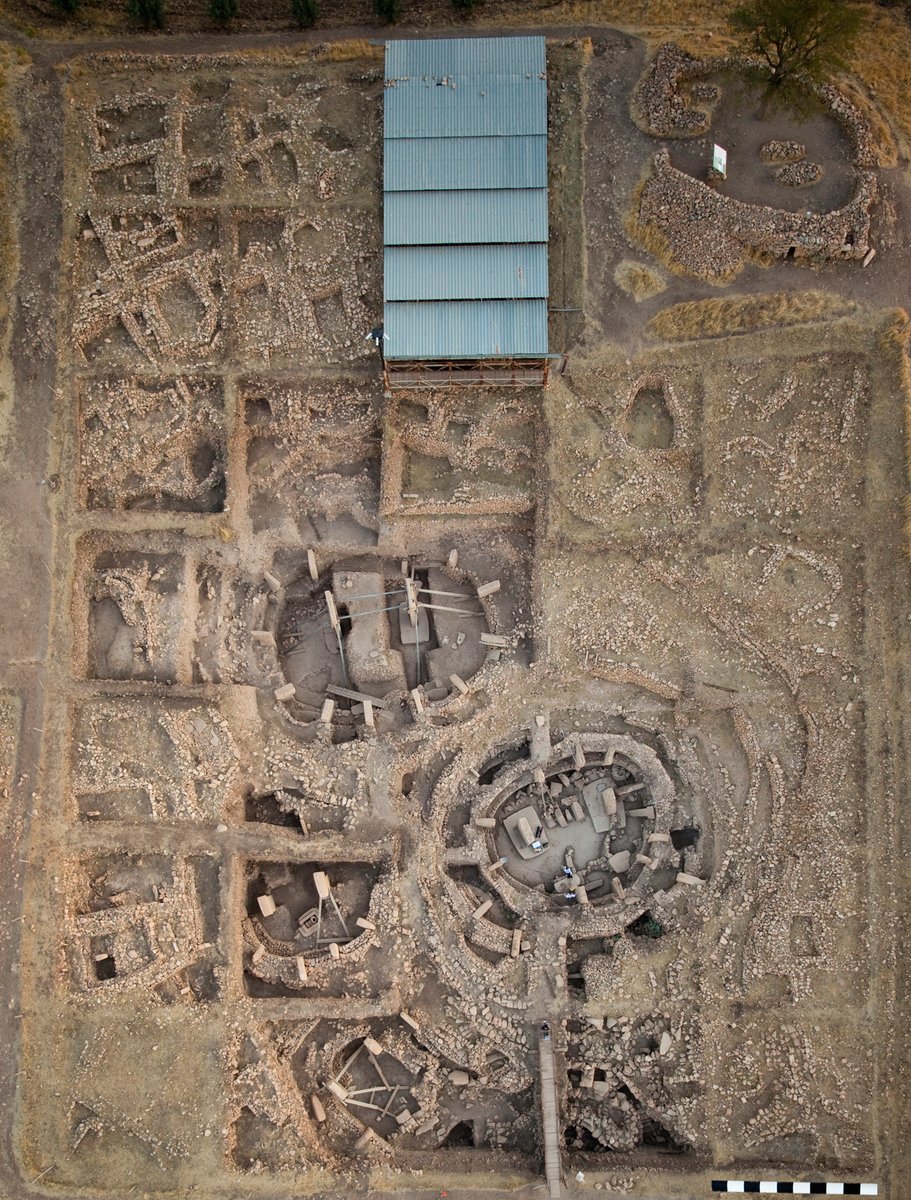
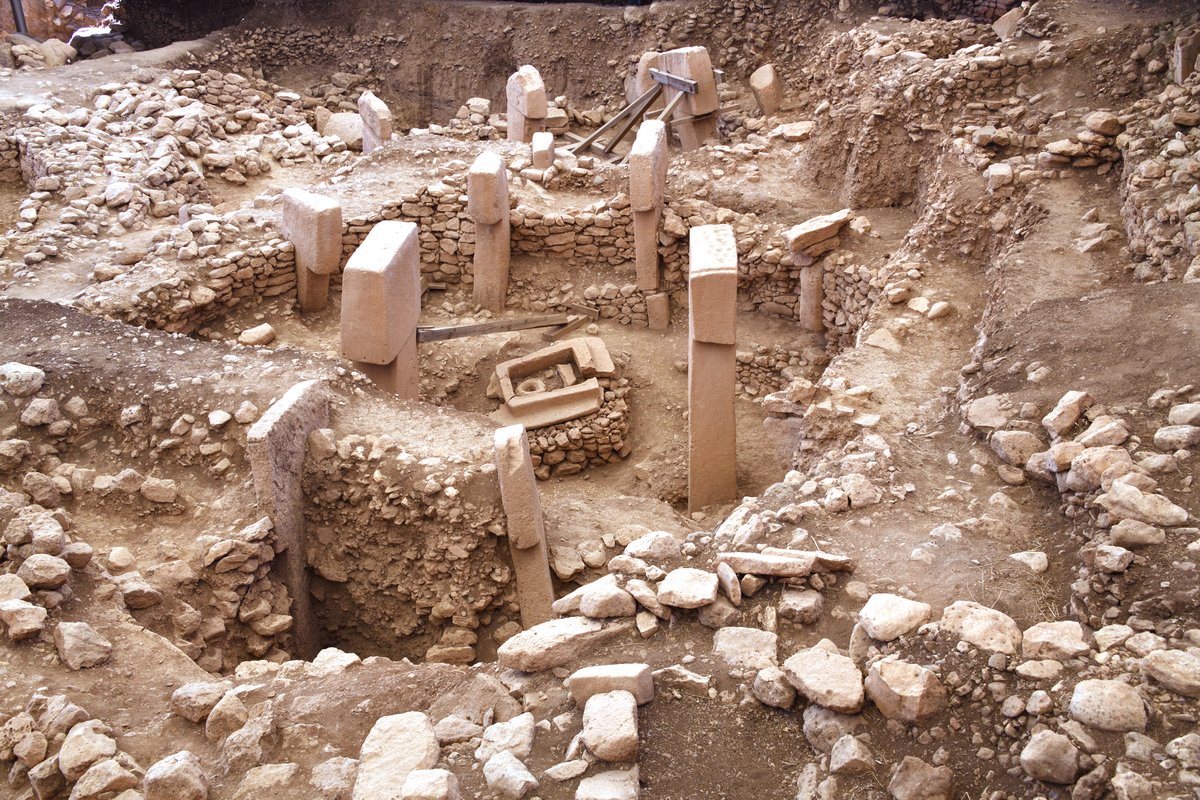
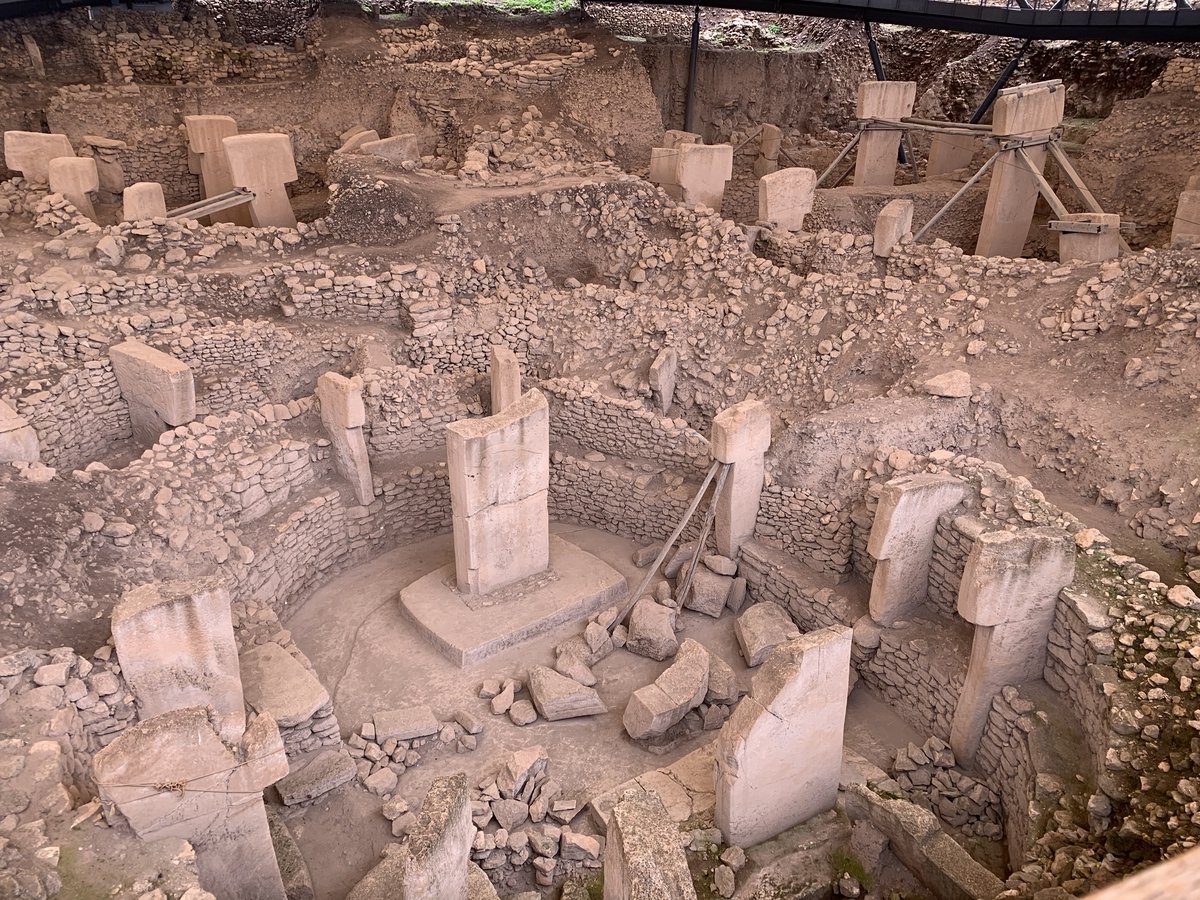
Each enclosure follows a consistent structural logic. The perimeter is defined by low stone benches and walls. Within that perimeter, two tall central pillars stand facing each other at the centre of the circle, surrounded by a ring of shorter peripheral pillars arranged at intervals around the interior. The enclosures range from about 10 to 30 metres in diameter. The pillars are T-shaped in cross-section: a tall rectangular shaft capped by a broad horizontal slab, a form that appears deliberately anthropomorphic. The central pillars in each enclosure are consistently larger than the perimeter pillars, sometimes reaching 5.5 metres in height and estimated weights of 10 to 20 tonnes.
The stone is local limestone, quarried from outcrops approximately 500 metres from the site. In the unfinished quarry areas, archaeologists have found pillars that were never removed from the bedrock, lying where they were abandoned mid-extraction. The largest of these unfinished pillars is approximately 7 metres long and would have weighed around 50 tonnes. The tools used to cut them were flint.
The Carvings
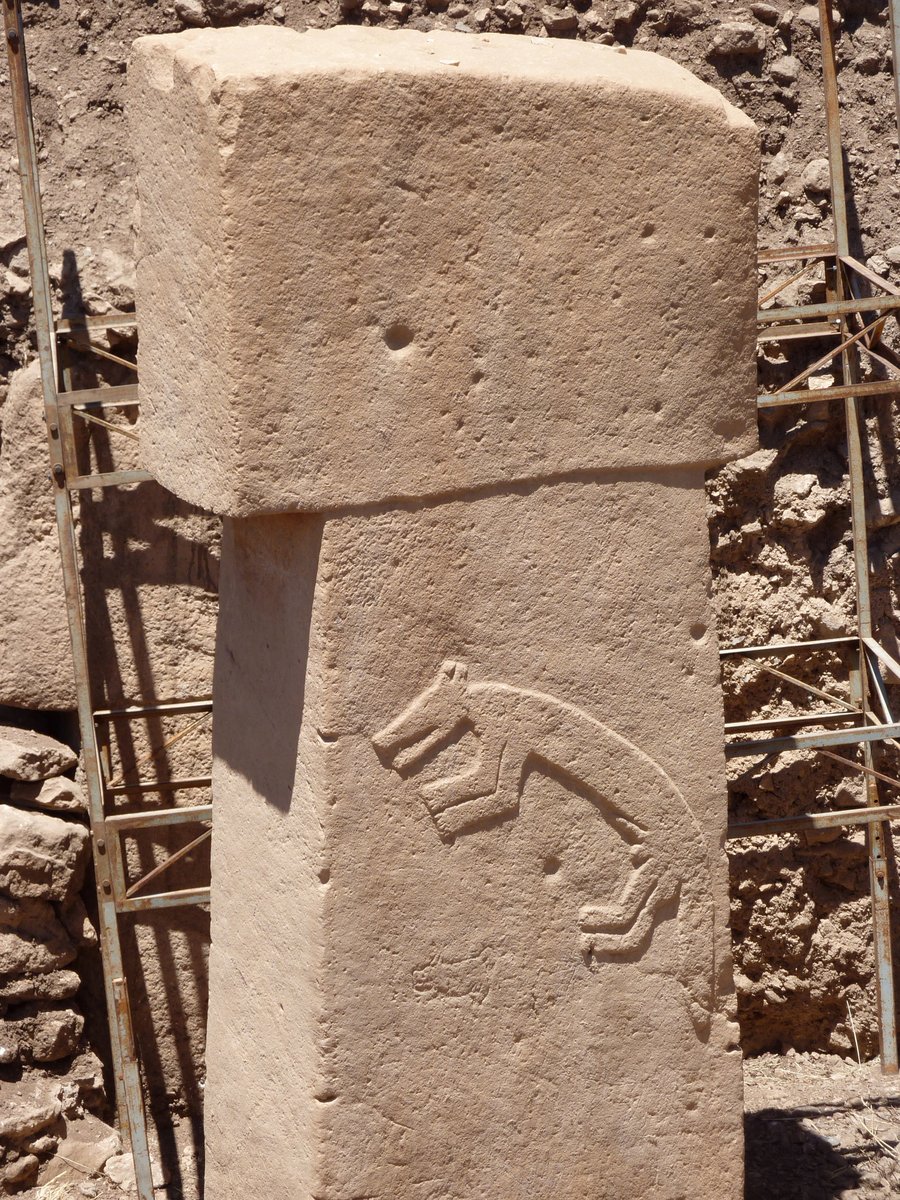
The pillars are not plain. Every surface is covered in carved relief images of animals, and the quality of the carving is high.
Peters and Schmidt's 2004 zooarchaeological analysis of the animal imagery catalogued the species represented across the site: foxes, snakes, lions, wild boar, cattle, cranes, ducks, spiders, scorpions, and vultures appear repeatedly. What is immediately striking is the pattern of what is absent. The animals depicted are overwhelmingly predators, scavengers, and dangerous species. Gazelle and deer, the animals the site's builders actually hunted for food based on faunal remains in the fill, appear almost exclusively as prey in hunting scenes. The carved world on the pillars is one of threat.
The central pillars carry an additional layer of imagery that distinguishes them from the perimeter pillars. Running along the lower shaft of many central pillars are carved arms: bent at the elbow, with hands meeting at the front of the body near a carved belt. The T-shaped top, the arms, the belt, the loincloth-like element below — these central pillars are clearly depicting beings in a stylised human form. Whether they represent deities, ancestors, or something else has been debated since the excavations began.
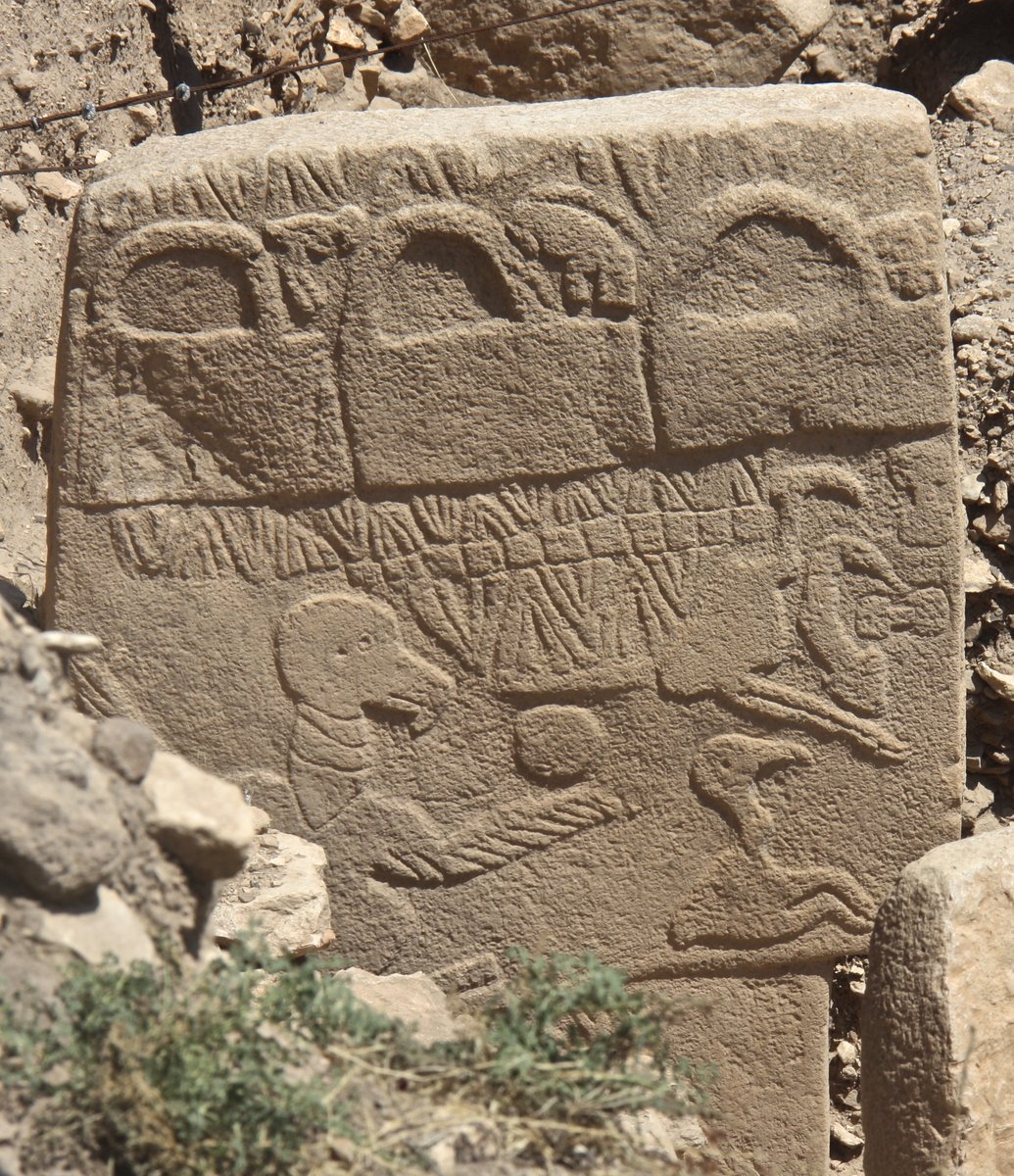
Pillar 43 in Enclosure D, known informally as the Vulture Stone, is the most discussed single carving at the site. It shows two large vultures with extended wings flanking a headless human figure with an erect phallus, surrounded by other animals and what some researchers have proposed represent constellations. Schmidt and colleagues interpreted the composition as funerary imagery: vultures excarnating the dead, a practice known from other Anatolian Neolithic contexts. A small number of researchers have proposed a different reading, that the composition depicts a specific astronomical event or even a comet impact, though the mainstream archaeological interpretation remains funerary symbolism.
Who Built It and How
The dating is unambiguous. Radiocarbon dates from organic material in the fill and from material associated with the construction phases place the oldest enclosures — Enclosures C and D — at approximately 9600 to 9000 BC. This is the Pre-Pottery Neolithic A period. Later enclosures, including the more recently identified rectangular structures on the eastern plateau, date to the Pre-Pottery Neolithic B, roughly 8800 to 8000 BC. Göbekli Tepe predates Stonehenge by approximately six thousand years and the Egyptian pyramids by seven thousand. It is the oldest known monumental architecture in human history.
The people who built it had no metal tools. They had no wheel. They had no writing system. They had no pottery. And, at the time of the earliest construction phases, they appear to have had no permanent settlements. The evidence from faunal and botanical remains in the fill is consistent with mobile hunter-gatherers: wild aurochs, gazelle, red deer, and wild einkorn wheat, all undomesticated. The people who quarried, transported, and erected stones weighing ten to twenty tonnes were doing so without the organisational infrastructure of agriculture.
How the stones were transported from the quarry to the enclosures, a distance of around 500 metres that includes a change in elevation, is not known. Experimental archaeology conducted in 2020, published in the Cambridge Archaeological Journal, demonstrated that twelve to twenty-four people working with ropes, wooden sledges, and tree-trunk rollers could move pillars of the sizes found at Göbekli Tepe within the span of a few months. This collapses earlier assumptions about the site requiring thousands of workers or some form of coerced mass labour. The logistics are demanding. They are not impossible for a mobile community.
"Göbekli Tepe is a 'Neolithic mountain sanctuary,' a great ceremonial centre which was the focus of a regional cult in use for millennia."
— Klaus Schmidt, Documenta Praehistorica, 2010
The Deliberate Burial
Around 8000 BC, the site was filled in. Not abandoned: filled. Tens of thousands of cubic metres of soil, animal bones, and flint tools were packed into the enclosures by human hands. Every pillar was buried. Every carved surface was covered. The fill was dense enough to preserve the carvings perfectly for ten thousand years.
The bones in the fill are almost entirely wild animals, the same species depicted on the pillars. Dietrich and colleagues' 2012 analysis in Antiquity examined the feasting remains in the fill in detail and found evidence of large-scale communal meals: aurochs, gazelle, and red deer processed in quantities far exceeding what a small group would consume, alongside wild cereals and fruits. The fill was not debris from ordinary habitation. It was the accumulated material of repeated gatherings, deposited deliberately.
Why the burial was carried out remains one of archaeology's genuinely open questions. Schmidt's interpretation was ritual decommissioning: the enclosures had served their purpose, the community buried them as a concluding act, and new construction began elsewhere on the site. Post-2014 research has examined whether some of the covering was accelerated by natural processes, including slope wash and possible landslide events. The consensus remains that the burial involved significant human effort and was not accidental. No inscription, no object, no parallel site has yet explained the motive.
The Temple-First Hypothesis
Schmidt's most controversial claim was not about the age of the site. It was about what the site meant for the standard model of human prehistory.
The conventional sequence ran like this: hunter-gatherers settled in one place, agriculture developed, food surpluses allowed population growth and specialisation, complex social organisation emerged, and eventually monumental architecture and ritual life became possible. The settlement comes before the temple. The surplus comes before the ceremony.
Göbekli Tepe, Schmidt argued, inverted that sequence. Hunter-gatherers with no agriculture, no pottery, and no permanent settlements built a monumental ceremonial complex requiring sustained coordinated labour over generations. The need for communal ritual gathered people together. Feeding those people over extended periods of construction and ceremony may have created the pressures that drove agricultural domestication in the first place. The temple came first. The farm followed.
This argument gained significant traction in popular science and was influential in the field. The wild einkorn wheat at Göbekli Tepe, it was noted, grows naturally in the region. The site sits in the Fertile Crescent, the zone from which wheat, barley, lentils, and chickpeas were all domesticated. Schmidt and others proposed that the labour demands of Göbekli Tepe created incentives to move from harvesting wild grain to cultivating it.
The temple-first hypothesis remains contested. Ian Hodder, excavator of Çatalhöyük and one of the most prominent figures in Neolithic studies, has argued that Schmidt's framework overstates the case. Hodder contends that Göbekli Tepe is better understood as a seasonal aggregation site: a place where mobile hunter-gatherer groups converged periodically for communal activities, which need not have had the transformative relationship to agriculture Schmidt proposed. The site may have been one node in a wider network of activity rather than the single causal point of the Neolithic transition.
Post-2014 excavations under Necmi Karul have further complicated the picture. New domestic structures, stone grinding basins, and water cisterns found at the site suggest that people did not only visit for ceremonies: they lived there, at least seasonally. This makes the ritual-only interpretation harder to sustain, but it also does not straightforwardly support the temple-first causal claim. The relationship between Göbekli Tepe and the origins of agriculture in the region is real. The direction of causation remains debated.
Layer C and the Deeper Structure
The enclosures that dominate public understanding of Göbekli Tepe, the famous T-pillar circles of Enclosures A through D, belong to what archaeologists call Layer II. They date roughly to 9000 to 8000 BC. But excavations since 2012 have identified an older layer beneath them, designated Layer III, and more recently an even older set of smaller circular structures now termed Layer C that pre-date even the earliest T-pillar enclosures.
Layer C structures are smaller, their pillars less imposing, and the animal imagery less elaborate. They push the beginning of monumental activity at the site back further into the Pre-Pottery Neolithic A, possibly to around 9600 BC or earlier. The stratigraphy at Göbekli Tepe is not simple. The site was in active use and being rebuilt over a period of at least 1,500 years. What began as a gathering place was continually elaborated, modified, and eventually buried in layers that accumulated over a millennium and a half.
After Schmidt
Klaus Schmidt died in July 2014 of a heart attack. He was 60 years old. The excavation he had built over two decades continued under the direction of Lee Clare of the German Archaeological Institute, in partnership with the Şanlıurfa Museum and the Turkish Ministry of Culture and Tourism. Current excavation director Necmi Karul of Istanbul University leads the joint project.
The pace of discovery has not slowed. In 2023, new ground-penetrating radar surveys mapped additional enclosures at depth, suggesting the full extent of the site is substantially larger than the area Schmidt excavated. Based on the geomagnetic surveys, at least twenty enclosures have been identified. Only six have been excavated. Roughly ninety percent of Göbekli Tepe remains underground.
In September 2025, excavators working in the corridor between Structures B and D uncovered an anthropomorphic statue embedded horizontally in the masonry. The figure had been placed there during construction, deliberately built into the wall. Its head and upper torso were intact. Its feet were missing. Karul described it as "a highly valuable discovery." What it was, what it represented to the people who placed it there, and what it was meant to guard remain unanswered.
What Remains to Be Found
Göbekli Tepe was designated a UNESCO World Heritage Site in 2018. A visitor centre opened in 2019. A permanent protective roof structure now covers the main excavation area, and plans for long-term conservation are in place. The German Archaeological Institute's project blog, The Tepe Telegrams, provides regular updates from the excavation team.
What the site ultimately means for the human past is still being worked out. The old framework, agriculture first, temples later, has been complicated by Göbekli Tepe in ways the field has not finished absorbing. The question of whether communal ritual can precede and possibly drive the conditions for settled life is no longer a fringe idea. It is a serious hypothesis supported by evidence from one of the most significant archaeological discoveries of the twentieth century.
The people who built Göbekli Tepe left no writing. They left no names. They left stone circles covered in carved predators, a hill full of feasting remains, and a man built into a wall with his feet removed. Then they buried all of it by hand and walked away. Ten percent has been uncovered. The other ninety percent is still waiting, in the dark, where they left it.